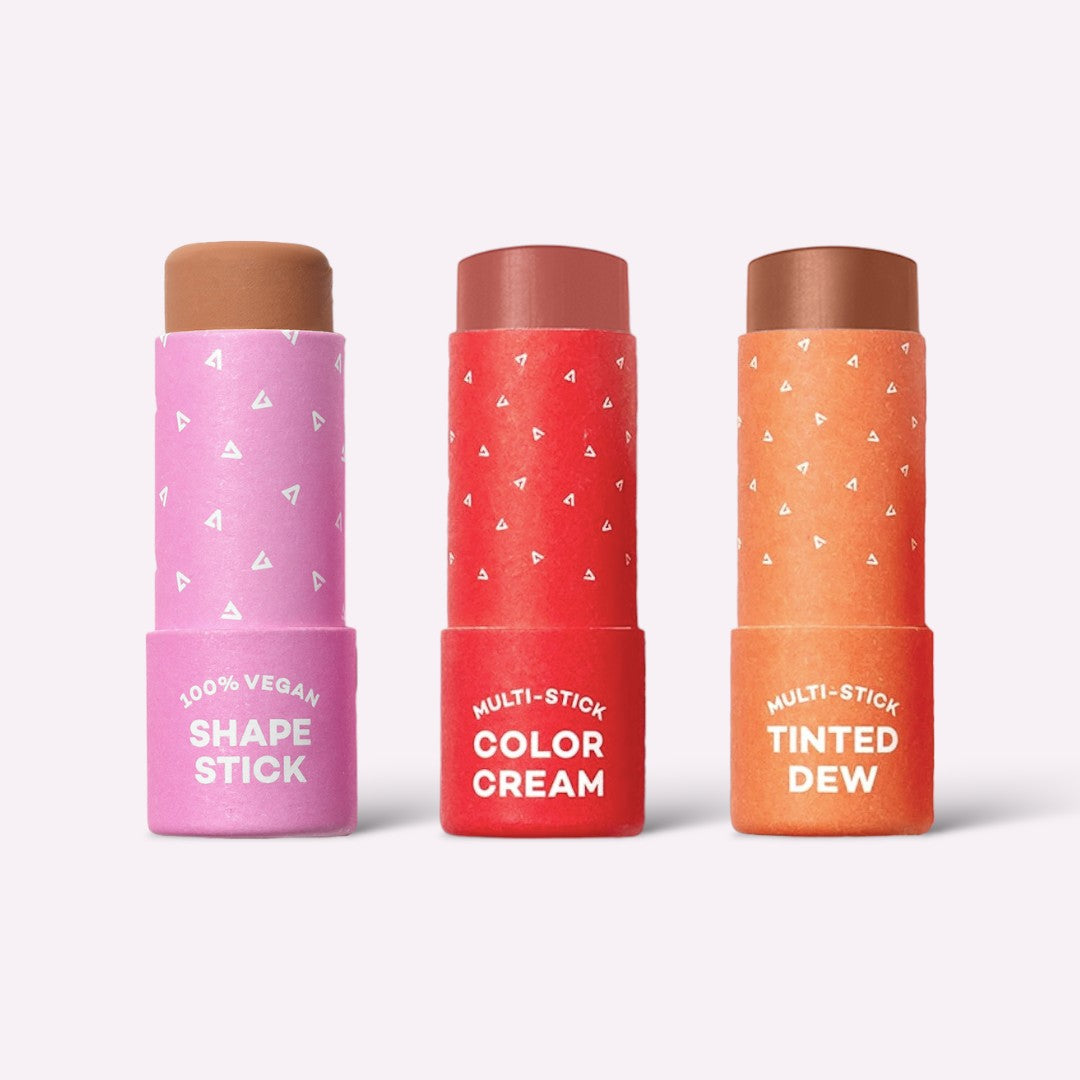
Eco friendly beauty products are designed to do as little harm as possible to the planet throughout their entire life. That means everything from using sustainably sourced ingredients to wrapping it all up in minimal-waste packaging. Think of it as a promise to care for your skin and the planet at the same time.
Real eco-friendly beauty isn't about just one green feature; it's a full-on commitment.
Unpacking the Meaning of Eco Friendly Beauty
Ever stood in a store aisle, staring at a wall of products all shouting "green," "natural," or "clean," and just felt… lost? You are definitely not alone. The phrase "eco friendly beauty products" gets thrown around a lot, but what it actually means goes way deeper than a slick label.
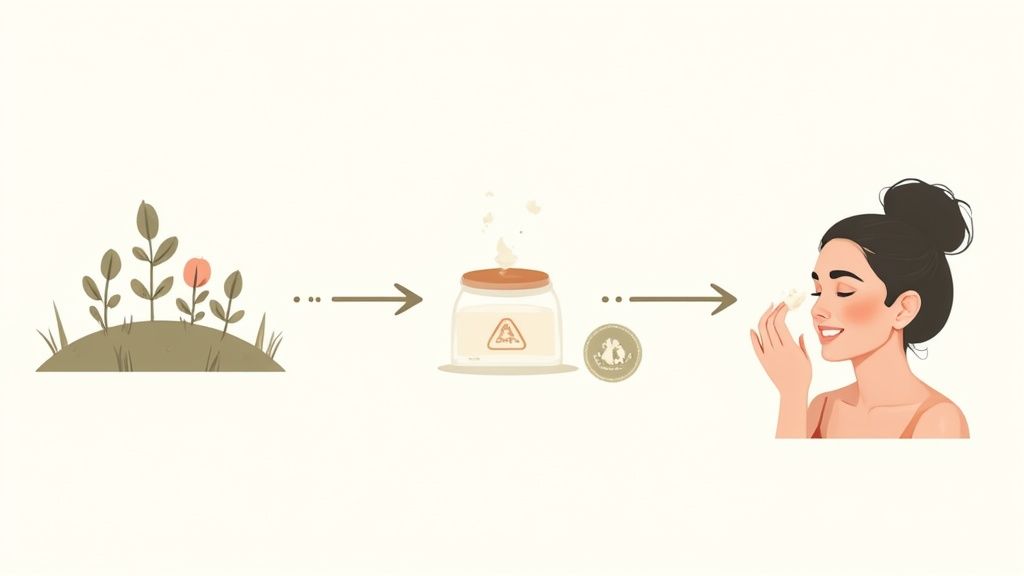
Imagine a product's life as a journey, from the farm all the way to your face and what happens after. A genuinely eco-friendly product has its impact considered at every single stop along that path. This big-picture view is what separates the truly sustainable brands from the ones just trying to sound good.
More Than Just a Label
To really get it, it helps to see how all these different terms fit together. Think of "eco-friendly" as the ultimate goal, and all the other buzzwords are different ways to get there.
- Green Beauty usually zeroes in on using natural, plant-based ingredients. That’s a great start, but it doesn’t always cover how those ingredients were sourced or what kind of packaging is used.
- Clean Beauty is all about formulas that are free from potentially iffy stuff like parabens and phthalates. This puts human health first, which—surprise!—often overlaps with what's good for the planet.
- Vegan Beauty means zero animal-derived ingredients are used. So long, beeswax and carmine.
- Cruelty-Free Beauty is the guarantee that no animal testing happened at any point.
Here's the catch: a product can be vegan but still come in a plastic tube that will never be recycled. Or it can be clean but use ingredients that were harvested unsustainably. True eco-friendly beauty tries to tick all the boxes.
The real goal is to find products where your personal well-being and the planet's health are in total harmony. It's not about picking one over the other; it's about seeing that they're completely connected.
The Four Pillars of Conscious Beauty
So, what should you actually be looking for? A truly sustainable product stands on four core pillars. It’s a commitment to a better way of making and using beauty products.
First, the formulas need to be non-toxic and biodegradable, so they don’t mess up our waterways when they wash down the drain. Second, ingredients should come from responsible sources that protect biodiversity and treat workers fairly.
Third—and this is a big one—the packaging has to be designed to be minimal, refillable, reusable, or at least super easy to recycle. The beauty industry pumps out an estimated 120 billion units of packaging every year, so this is a huge deal. Finally, the whole operation must be cruelty-free, respecting animals every step of the way.
Once you get these basic principles, you can see right through the marketing fluff. It gives you the power to think critically about your choices and build a beauty routine that actually makes a positive difference.
How to Read Labels and Certifications
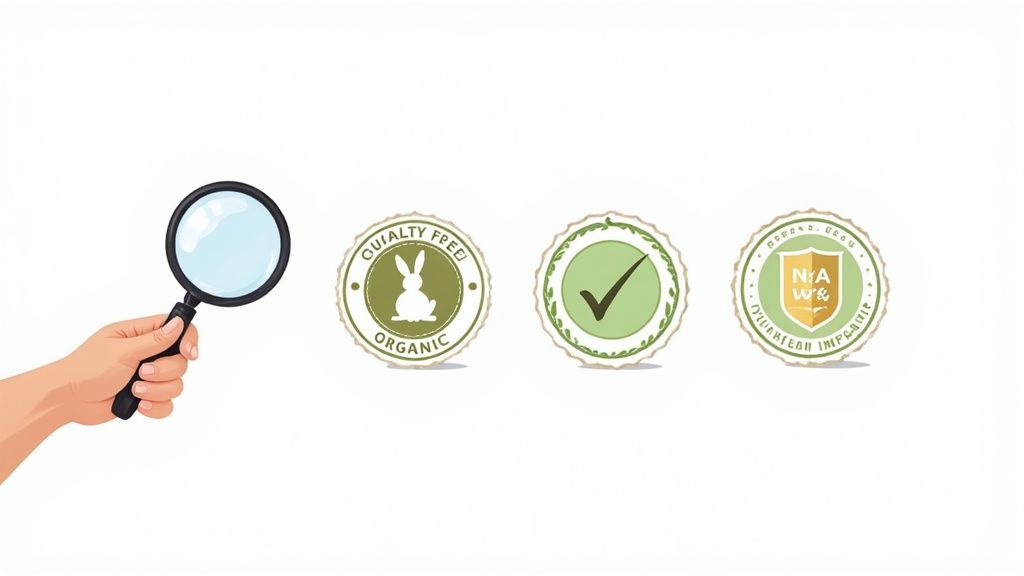
Trying to figure out all the symbols and logos on beauty products can feel like learning a new language. With so many brands making big promises, these official certifications are your best friend—they cut through the marketing noise and show you which companies are actually walking the walk.
Think of these labels as a product’s resume. They prove that a brand has put in the work to meet strict, third-party standards. So you don't have to just take their word for it. Getting to know the most common seals is your first step to becoming a super-savvy, conscious shopper.
This push for transparency is changing everything. The clean beauty industry is blowing up, with health and beauty e-commerce sales expected to jump by 77% between 2021 and 2026. A whopping 63% of shoppers say clean beauty is 'extremely' or 'very important' to them, so knowing your labels is more essential than ever. You can dive deeper into these trends in this detailed report on clean beauty statistics.
Decoding the Most Common Logos
Heads up: not all certifications are created equal. Some focus on a single issue, like animal welfare, while others look at a company’s entire operation. Knowing the difference helps you pick products that truly line up with your values.
Here are a few of the most trusted seals you’ll see out there:
- Leaping Bunny: This is the gold standard for cruelty-free. It’s a guarantee that no animal testing happened at any point, from the raw ingredients to the final lipstick you’re holding.
- USDA Organic: This seal from the U.S. Department of Agriculture means that at least 95% of the product's ingredients are certified organic. They were grown without synthetic pesticides, sketchy fertilizers, or GMOs.
- ECOCERT: A globally recognized certification for organic and natural cosmetics. ECOCERT has two main labels: "Organic Cosmetic" requires that at least 95% of plant-based ingredients are organic, while "Natural Cosmetic" requires a minimum of 50%.
- Certified B Corporation: This one is a big deal. It doesn’t just look at the product; it grades the entire company on its social and environmental impact, accountability, and transparency.
Spotting Greenwashing and Vague Claims
Unfortunately, for every legit certification, there are a ton of sneaky marketing tricks. This is called greenwashing—when brands use fuzzy or irrelevant claims to make a product seem way more eco-friendly than it actually is.
Learning to tell the difference between a meaningful certification and empty marketing fluff is a superpower for any conscious consumer. Look for proof, not just promises.
To avoid getting duped, watch out for unregulated buzzwords. Terms like "eco-friendly," "natural," "green," or "chemical-free" have no official legal definition in the beauty industry. Some brands use them honestly, but others just slap them on the package to give a false impression. You can learn how to see right through these tactics by breaking down sustainability buzzwords in our guide.
Always look for a recognized, third-party certification to back up a brand's claims. If you see a logo you don’t recognize, a quick search will tell you if it’s legit or just a pretty graphic. Becoming a label detective puts the power back in your hands, ensuring the products you buy are genuinely better for you and the planet.
Choosing Sustainable Ingredients
The real heart of any eco-friendly beauty product is its ingredient list. It’s a lot like cooking—the quality of your meal comes down to the quality of your ingredients. The same goes for your face. A product’s formula is what really determines its impact on your skin and the planet.
But “sustainable ingredients” means more than just being “natural.” It’s about looking at the entire lifecycle—how something is grown, how it’s harvested, and what happens after it gets washed down the drain. This big-picture approach makes sure that what’s good for your skin isn’t trashing our ecosystems.
Ingredients to Embrace
When you’re scanning a label, keep an eye out for ingredients that are renewable, biodegradable, and sourced with fairness in mind. These are the good guys in a sustainable formula, working with nature instead of against it.
Here are a few of our favorites:
- Fair-Trade Shea Butter: This powerhouse moisturizer comes from the Karitè tree in Africa. When it's fair-trade certified, it means local communities (often women-led co-ops) get paid a fair wage. Win-win.
- Bamboo: As one of the fastest-growing plants on earth, bamboo is a super renewable resource. It needs very little water and zero pesticides to thrive, making it a low-impact choice for everything from makeup brushes to powdered extracts.
- Algae and Seaweed: These marine botanicals are incredibly sustainable. They grow like crazy in the ocean without needing land or fresh water, and they’re packed with vitamins and minerals your skin will love.
The best sustainable ingredients do more than just work; they tell a story of ethical sourcing, environmental respect, and community support. Choosing them is a vote for a healthier, more equitable supply chain.
The Rise of Waterless and Solid Beauty
One of the smartest ways to make a beauty product more eco-friendly? Just take out the water. Seriously. Most traditional liquid products are 60-80% water. That means bigger plastic bottles, more preservatives, and a heavier carbon footprint just to ship them around.
Solid or waterless alternatives—like shampoo bars, moisturizer sticks, or powder-to-paste face masks—concentrate the good stuff into a compact form. This simple switch cuts down on packaging waste, saves water, and usually gives you a product that lasts way longer.
Ingredients to Avoid
Knowing what to look for is only half the battle. You also need to know what to run away from. Some super common ingredients have well-known negative effects on our bodies and the environment, sticking around as pollutants long after we’ve used them.
Keep an eye out for these culprits on the label:
- Parabens (e.g., methylparaben, propylparaben): Used as preservatives, these chemicals can mess with hormones and have been found in marine animals. That’s a huge red flag for how long they persist in our ecosystems.
- Phthalates (often hidden as "fragrance"): These are used to make scents stick around, but they’re linked to endocrine disruption. Once they’re washed away, they pollute our water. When choosing products for a healthy home, it’s just as important to prioritize safe, natural components, a topic covered in Your Guide to the Best Non-Toxic Home Fragrance.
- Microplastics (e.g., polyethylene, polypropylene): These tiny plastic bits are often used as cheap exfoliants or fillers. They’re too small to be filtered out by water treatment plants, so they end up in the ocean, where they’re eaten by marine life and work their way right back up the food chain.
Getting familiar with the heroes and villains on an ingredient list is a game-changer. That simple habit of scanning labels turns you from a passive shopper into an active part of the movement for healthier, more sustainable beauty.
Solving The Beauty Packaging Problem
If a product’s ingredient list is its heart, then its packaging is the protective shell. And right now, that shell is creating a colossal mess. The beauty industry is a huge contributor to global waste, churning out an estimated 120 billion units of packaging every single year.
It’s a staggering number. When you realize that only about 9% of all plastic packaging ever made has been recycled, the scale of the problem really hits home. The rest? It’s sitting in landfills or, worse, polluting our oceans.
But here’s the good news: this challenge is sparking some serious innovation. Brands and shoppers are coming together to completely rethink what packaging can be, turning a waste crisis into a chance for brilliant, eco-conscious design.
While we're talking about packaging, it’s what's inside that counts, too. This visual gives you a quick rundown of the good vs. the bad when it comes to ingredients.
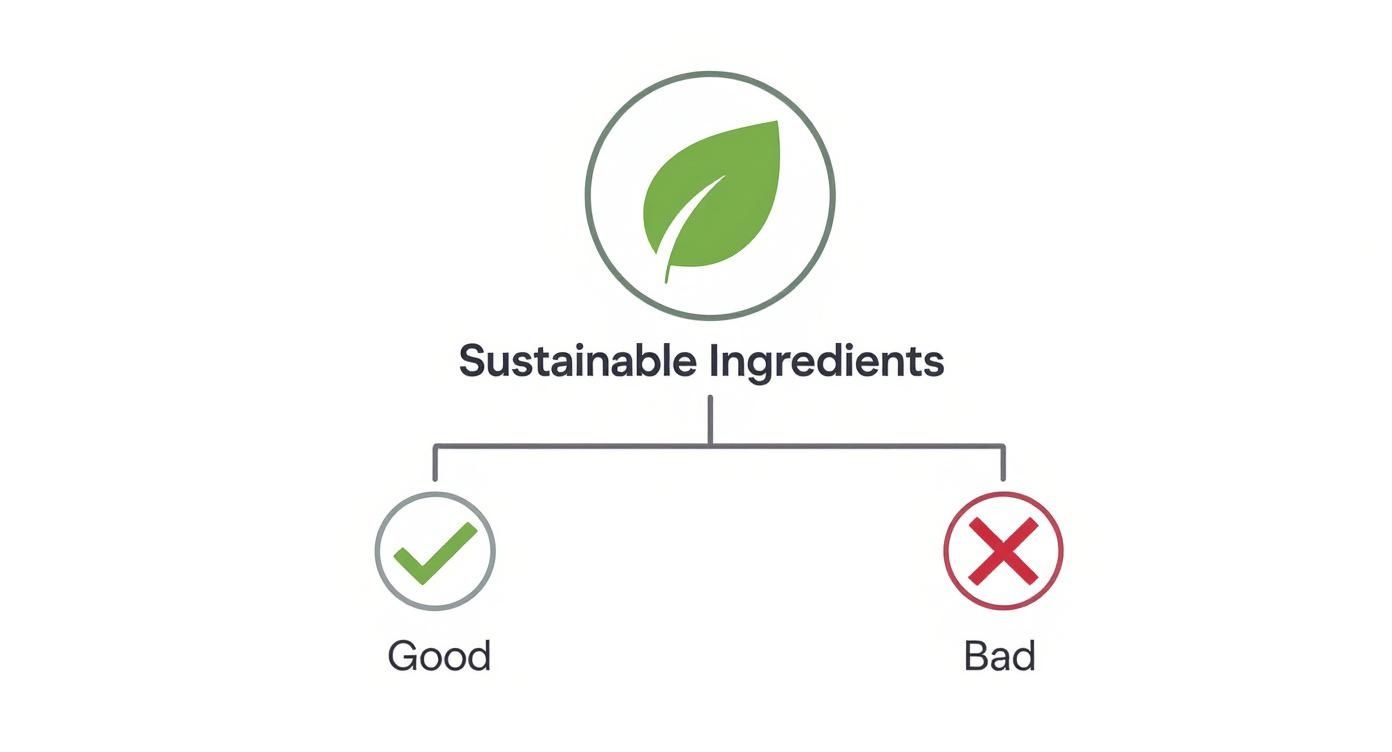
Think of it as a mental cheat sheet for spotting truly sustainable formulas when you're shopping.
Applying The Waste Hierarchy To Your Beauty Routine
To really make a dent in packaging waste, we can borrow a simple but powerful idea from environmental science: the waste hierarchy. Imagine it as a pyramid, with the most effective actions right at the top.
It all boils down to Reduce, Reuse, Recycle—and that order is crucial.
-
Reduce: The absolute best thing you can do is avoid creating waste in the first place. That means looking for package-free or "naked" products, like solid shampoo bars, conditioner bars, and our own Balmies. No box, no tube, no problem.
-
Reuse: Next up is giving packaging a second, third, or even hundredth life. Refillable systems are a game-changer here. You buy one durable container and just keep topping it up with refills that use way less packaging.
-
Recycle: This is your last line of defense. Recycling is important, but it uses a lot of energy and isn't a perfect system. It should always be the final step after you've tried to reduce and reuse.
By keeping these priorities straight, you can seriously shrink the environmental footprint of your beauty routine.
Eco-Friendly Packaging Alternatives
As brands move away from virgin plastic, a new wave of sustainable materials is taking center stage. Each one offers a smarter way to house our favorite products. Choosing brands that use these materials is a direct vote for a healthier planet.
| Material | Pros | Cons | Best For |
|---|---|---|---|
| Glass | Infinitely recyclable without losing quality. Feels luxurious and preserves formulas well. | Heavier than plastic, which can increase shipping emissions. Can be fragile. | Serums, foundations, facial oils, and creams. |
| Aluminum | Lightweight and infinitely recyclable, just like glass. Durable and protects from light. | Can be easily dented. Often requires a plastic liner for certain formulas. | Deodorants, lip balms, and dry shampoos. |
| Bamboo | Fast-growing, renewable resource. Biodegradable and naturally antibacterial. | Not all bamboo is sustainably sourced. Can be combined with plastic parts. | Lids, caps, brush handles, and compacts. |
| PCR Plastic | Gives existing plastic a second life, keeping it out of landfills and oceans. Lower carbon footprint than virgin plastic. | Can have slight color imperfections. Not infinitely recyclable; quality degrades over time. | Bottles for shampoo, conditioner, and body wash. |
These materials represent a huge step forward, proving that we don't need to rely on single-use plastics to create beautiful, functional packaging.
Making Your Recycling Efforts Count
Even the most eco-friendly container is useless if it ends up in the wrong bin. To make sure your good intentions don’t go to waste, you have to become a bit of a recycling expert.
First, always clean out your containers. That last bit of lotion or foundation can contaminate an entire batch of recyclables, sending it straight to the landfill. Just scrape out what you can, then give it a quick rinse with soap and water. For a deeper dive, check out our complete guide to eco-friendly packaging in cosmetics.
Second, get to know your local rules. Recycling guidelines can be wildly different from town to town. What’s accepted in your friend's city might be trash in yours.
Finally, for those tricky items—think pumps, droppers, or caps made of mixed materials—look for brand take-back programs or mail-in services like TerraCycle that handle hard-to-recycle beauty packaging. Taking that extra step ensures every little piece finds its way to the right place.
How to Switch to an Eco Friendly Routine
Making the jump to an eco-friendly beauty routine should feel good, not like a homework assignment. And the biggest secret? You don't have to toss everything you own and start from zero. The most sustainable way to do it is built on one simple, powerful idea: progress, not perfection.
Think about it like refreshing your wardrobe. You wouldn’t empty your entire closet at once. Instead, you'd slowly swap out pieces as they wear out, choosing better, more consciously-made items to replace them. This is the exact same logic you can apply to your makeup bag and shower shelf.
Start with Small, Gradual Swaps
The most powerful strategy is also the easiest. Just use up the products you already have! When that bottle of lotion or tube of mascara is finally empty, that's your moment to replace it with a more thoughtful option. This approach is way kinder to your wallet and keeps perfectly good products out of the landfill.
Going slow makes the whole process feel totally manageable. It turns what could be a huge, overwhelming project into a series of small, satisfying wins and gives you time to actually research your new go-to eco friendly beauty products.
Create Your Eco Friendly Starter Kit
Ready to make your first few changes? Some swaps deliver a huge impact with almost no effort. Kicking things off with these easy wins can build some serious momentum and show you just how simple this can be.
Here are a few ideas to get your starter kit going:
- Solid Shampoo and Conditioner Bars: These completely eliminate plastic bottles and are a dream for travel. One bar often outlasts two or three bottles of the liquid stuff, making it a surprisingly budget-friendly move.
- Reusable Cotton Rounds: Instead of tossing a cotton pad every single day, switch to washable rounds made from organic cotton or bamboo. You just throw them in the laundry. Easy.
- Refillable Deodorant: So many brands now offer a beautiful, durable case you keep forever, and you only have to buy the deodorant refills. This cuts way down on single-use plastic.
- A Multi-Use Color Stick: A single crayon that works for your lips, cheeks, and even your eyes streamlines your routine like nothing else. It means buying (and carrying) fewer products overall. Our Axiology Balmies are perfect for this, since they're zero-waste and totally package-free.
Building a sustainable routine isn't about giving things up; it's about making smarter, more intentional choices that actually feel good. Every little swap is a vote for a healthier planet.
Find Your Go-To Sustainable Brands
Knowing where to shop is half the battle. The good news is that finding incredible eco-conscious brands is easier than it's ever been. Dedicated zero-waste online shops are amazing for this, as they curate all the best products in one spot.
But you don’t always have to go searching. Many big stores now have sections just for clean and sustainable beauty. Keep an eye out for brands that are upfront and transparent about their ingredients, sourcing, and packaging. If you want a head start, check out our guide to some of the top sustainable beauty brands making a difference.
Make Your Routine Budget-Friendly
There's a myth that living sustainably is expensive. And sure, some niche products might have a higher price tag, but an eco-friendly routine can genuinely save you money. The trick is to shift your thinking from cost-per-product to cost-per-use.
Multi-use products are the perfect example. One color stick that replaces your blush, lipstick, and eyeshadow means you're buying one item instead of three. It's the same with solid products—they're super concentrated and last so much longer than their liquid, water-filled versions. When you focus on versatility and longevity, you'll find that a conscious routine isn't just doable, it's actually pretty affordable.
Got Questions About Eco-Friendly Beauty?
Making the switch to a more conscious beauty routine always brings up a few questions. Trust us, it's totally normal to wonder about things like price, if the products actually work, and what on earth to do with your old stuff. We’ve got you covered.
Think of this as your quick-and-dirty guide to the little details that make a huge difference. Let's clear up those common concerns so you can feel good about your journey.
Are Eco-Friendly Beauty Products More Expensive?
This is a huge myth, and the short answer is: not really. While some fancy organic brands might have a higher price tag upfront (thanks to ethical sourcing and premium ingredients), many eco-friendly beauty products actually save you money in the long run. The trick is to stop thinking "cost-per-bottle" and start thinking "cost-per-use."
A solid shampoo bar, for example, often lasts two or three times longer than its liquid counterpart. That makes it way more economical over time. And multi-use products, like a color stick for your lips and cheeks, mean you're buying fewer items overall. As more people demand sustainable options, affordable and accessible choices are popping up everywhere, proving you don't have to break the bank to be kind to the planet.
Do Natural Deodorants Actually Work?
Yes, they absolutely do—but you might need to give your body a minute to adjust. Conventional antiperspirants use aluminum to literally plug your sweat glands (yikes). Natural deodorants work differently. They let your body do its natural thing (sweat!) but use smart ingredients like baking soda, magnesium, or arrowroot powder to soak up moisture and neutralize odor.
When you first swap, you might go through a little "detox" period where you feel extra sweaty. That's just your pores clearing out and your body getting back to baseline. Finding the right formula for your body chemistry is key. Lots of brands offer travel sizes so you can experiment without committing to a full-size stick right away.
What Is The Easiest First Swap To Make?
If you want a simple first step that still makes a big impact, you can't go wrong with swapping your liquid hand or body wash for a classic bar of soap. Just like that, you’ve kicked one plastic bottle out of your routine. Bar soaps are usually wrapped in minimal, recyclable paper and are super-efficient.
Another fantastic, no-brainer swap is ditching disposable cotton rounds for reusable, washable pads. You just use them, toss them in with your laundry, and they're good to go again and again. These small changes are easy to stick with and really add up over time.
A sustainable lifestyle isn't built on one giant leap; it's the sum of many small, intentional steps. Starting with an easy win like bar soap builds momentum and proves just how manageable this transition can be.
How Can I Dispose Of Old Beauty Products?
Okay, this part is super important. First thing's first: never pour old lotions, serums, or makeup down the drain. The chemicals and oils can mess with aquatic ecosystems and totally overwhelm water treatment facilities.
Here’s the right way to handle it:
- Empty It Out: Scrape or wipe out as much product as you can and toss it in the regular trash.
- Clean It Up: Give the empty container a good wash with soap and water. Any gunk left behind can contaminate a whole batch of recycling, sending it all to the landfill.
- Check for Recyclability: Look for the little recycling symbol (the number inside the arrows) on the bottom. Then, check your local city or county's recycling rules, because they can be wildly different from place to place.
- Handle the Tricky Parts: For things like pumps, sprayers, or caps made of mixed materials, you’ll likely need a special program. Many brands now partner with services like TerraCycle to handle these hard-to-recycle bits.
Taking these extra steps gives your old packaging the best shot at becoming something new. And you’re not alone in caring about this stuff! The global market for natural and organic personal care is projected to hit $54.3 billion by 2032, all because of rising awareness. You can read more about it in the natural and organic personal care market report.
Ready to simplify your routine with products that are kind to your skin and the planet? At Axiology, we create 100% vegan, cruelty-free, and zero-waste makeup, like our plastic-free Balmies that you can use on your eyes, lips, and cheeks.
Explore our collection and join the planet-loving beauty movement at Axiology.