Before you even think about swatching a foundation on your jawline, there's a crucial first step. The real secret to a perfect match isn't just about how light or dark your skin is—that's the easy part. It’s about figuring out your skin’s undertone, the permanent, subtle color that lies just beneath the surface.
Getting this right is everything. It's the difference between a foundation that looks seamless and one that ends up looking too orange, too pink, or just plain off.
Your Guide to a Flawless Foundation Match
Let's be real: finding the perfect foundation can feel like an endless, frustrating quest. But it’s actually way simpler than you think once you know what to look for.
The biggest mistake people make is trying to match the surface color of their skin, which can change with a little sun exposure or even just throughout the day. Your undertone, on the other hand, never changes. It’s the constant, true hue of your skin.
Understanding Your Skin's Undertone
Your undertone is the color that comes through your skin from underneath, and it generally falls into one of three buckets: cool, warm, or neutral.
- Cool Undertones: Think hints of pink, red, or blue. If silver jewelry makes your skin pop, you’re likely in the cool family.
- Warm Undertones: Your skin leans more yellow, peachy, or golden. Gold jewelry is probably your best friend.
- Neutral Undertones: You’ve got a mix of both cool and warm hues. You can probably pull off both silver and gold jewelry without a problem.
Figuring this out instantly cuts your options down, making it so much easier to find a shade that looks like a second skin. It’s no wonder the inclusive shade foundation market is projected to hit around USD 8.2 billion. Brands are finally catching on, offering massive ranges with up to 40 shades to help everyone find their perfect undertone match. You can get more insights on this growing trend over at MarketIntelo.com.
A common myth is that fair skin is always cool-toned and dark skin is always warm-toned. That’s just not true. Any skin depth—from the very fairest to the deepest—can have any of the three undertones.
To make it even easier, here are a few simple tests you can do right now to get a better idea of where you fall.
Quick Guide to Identifying Your Undertone
Use these simple at-home tests to quickly figure out your skin's undertone.
| Test Method | Warm Undertone Clues | Cool Undertone Clues | Neutral Undertone Clues |
|---|---|---|---|
| The Vein Test | Your veins appear greenish. | Your veins look blue or purple. | Your veins are a mix of blue and green. |
| The Jewelry Test | Gold jewelry flatters your skin most. | Silver jewelry looks best on you. | Both gold and silver look great. |
| The White T-Shirt Test | You look better in off-white or cream. | You shine in crisp, bright white. | You can pull off both shades equally well. |
Once you've got your undertone nailed down, you can confidently walk past entire sections of the foundation aisle. All the guesswork is gone! The only thing left to do is find the right depth to match, and you're golden.
Mastering the Art of Swatching and Testing
Alright, you've figured out your undertone. Now for the make-or-break moment: actually testing the shades. So many people fall into the trap of swatching foundation on their wrist or the back of their hand. I get it, it's convenient. But the skin there is almost always a totally different color from your face.
For a true match, you have to test the foundation right where you'll be wearing it. My go-to spots are the jawline, the neck, and the center of the face. This gives you the best idea of how a shade will blend between your face and neck, helping you dodge that dreaded "floating head" look.
The Right Way to Swatch Foundation
When you're ready to get swatching, pick about three shades that look the most promising. Apply them in short, separate lines along your jawline, leaving a little space between each stripe. This is what we call the "stripe test," and it's the best way to see which shade truly melts into your skin.
Now, don't rush it. Give the swatches a few minutes to dry completely. Some foundations oxidize, meaning they can darken slightly as they set. The one that practically disappears without any harsh lines? That's your winner. If you need some tips on getting that seamless blend, we've got a great guide on how to apply foundation with a sponge.
This simple process is the key to finding your perfect match, from undertone to the final test.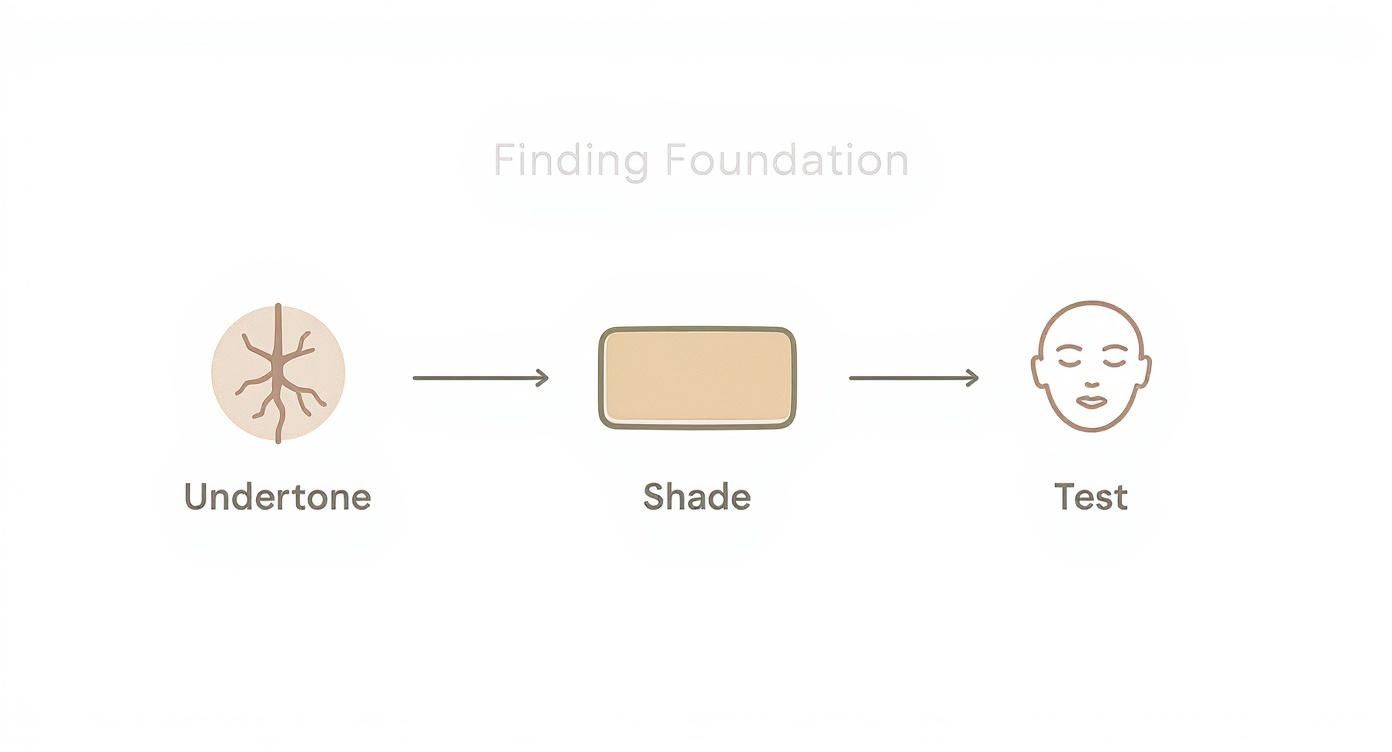
By nailing these steps in order—undertone, shade, and testing—you're creating a foolproof path to a flawless finish.
Lighting Makes All the Difference
Let's be real: store lighting is the worst. Those fluorescent lights often cast a cool, bluish glow that can make warm-toned foundations look completely off, sometimes even ashy. It’s the number one reason a shade that looks perfect in the aisle can be a total disaster once you step outside.
The most crucial tip I can give you is this: check your swatches in natural daylight. After you’ve applied your test stripes, find a window or, even better, step outside. This is the truest light, and it will reveal a shade’s real color.
Bring a small mirror with you. Check your jawline in the car, by a window, and then back under the lights in your own home. The shade that looks great in all these different settings is the one you can count on.
Navigating Online Shade Finders
Thankfully, shopping for foundation online isn't the guessing game it used to be. The foundation shade finder market is now valued at around USD 1.2 billion and is growing fast, mostly because AI and augmented reality (AR) are getting really good at helping us find a match from our couch. You can find more info on this at DataIntelo.com.
To get the most out of these tools, a few best practices go a long way:
- Use a high-quality photo: Snap your picture in bright, natural light. No filters!
- Answer honestly: Be specific about your skin concerns and what you think your undertone is.
- Cross-reference: Try the finders on a few different brand websites. If they all suggest similar shades, you're probably on the right track.
As you get the hang of swatching, you might want to look into other modern tools, too. For a deep dive, check out this ultimate guide to virtual try-on technologies. While these online tools are a fantastic starting point, I always recommend getting a physical sample to be 100% sure before you buy the full-size bottle.
Choosing the Right Formula for Your Skin Type
So you’ve found your perfect shade—amazing! But hold on, because choosing the wrong formula can completely derail the final look. We’ve all been there: a foundation that’s too dry clings to every little patch, while one that’s too hydrating slides right off your face by lunchtime.
The real secret is matching the formula not just to your color, but to what your skin is actually doing day-to-day.
Think of it like this: your skin type dictates the texture and finish that will look the most seamless and natural. If you have an oily T-zone, a mattifying liquid foundation can be a total game-changer, keeping shine in check without feeling heavy. On the flip side, someone with dry, thirsty skin will fall in love with a hydrating serum foundation that gives a dewy, plump finish that actually lasts.
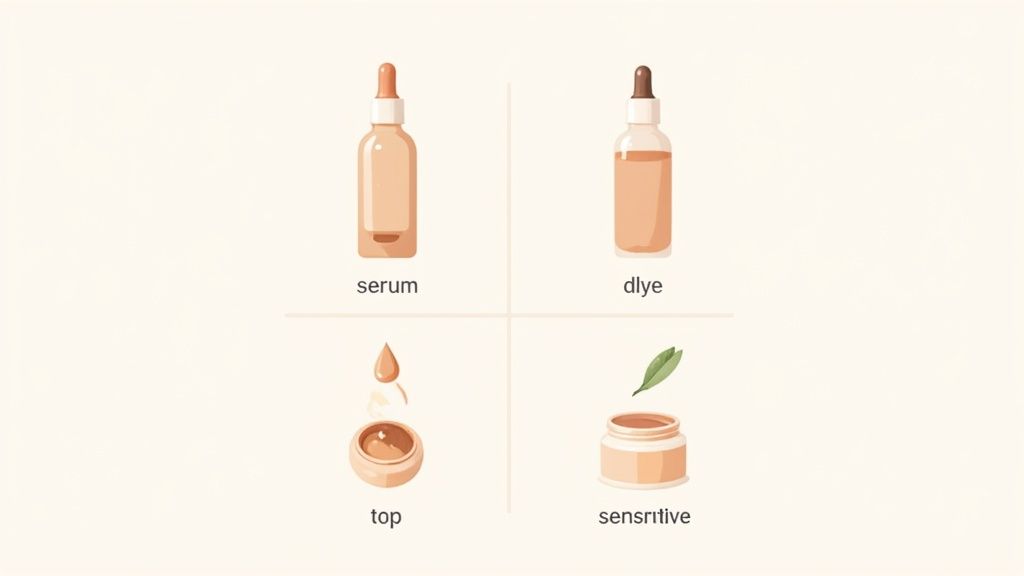
Matching Formula to Skin Concerns
Getting to know the different foundation types is the first step. Each one offers a distinct feel and benefit.
- Liquid Foundations: These are the most versatile players, available in finishes from matte to radiant. They work for most skin types, but if you're prone to breakouts, look for oil-free versions.
- Powder Foundations: Perfect for a quick, buildable application. They're a dream for oily skin because they absorb excess sebum like a charm.
- Cream Foundations: These offer more substantial coverage and a dewy finish, making them ideal for anyone with dry or mature skin.
- Serum Foundations: Super lightweight and often packed with skincare goodies, they give a sheer, skin-like finish. Perfect for those who want just a hint of coverage.
Combination skin can feel tricky, right? A good strategy is to use a more mattifying formula on your T-zone and a more hydrating one on your cheeks. Or, you can find a natural-finish foundation that strikes a happy medium for both areas.
A common mistake is picking a formula just for its coverage. Always, always prioritize your skin type first. A full-coverage matte foundation will only highlight dryness on dehydrated skin, no matter how well it covers imperfections.
Decoding Coverage Levels and Ingredients
Beyond the formula itself, think about the level of coverage you really want. Don't assume you need to go full-coverage just because you have a few blemishes. Sometimes, a lighter touch is way more flattering.
Coverage Options:
- Sheer: Think of this as a light wash of color. It evens things out but lets your natural skin show through. Perfect for every day.
- Medium: This is your buildable go-to. It can hide redness and minor imperfections while still looking like actual skin.
- Full: This is opaque coverage that conceals just about everything. It’s usually best reserved for special events or photos.
Finally, it’s time to turn the bottle around and scan the ingredient list. Foundations aren't just makeup anymore; they’re pretty much an extension of your skincare routine.
Here’s a quick guide to help you find the best match for your skin.
Foundation Formula and Skin Type Compatibility
| Skin Type | Best Foundation Formula | Ideal Finish | Key Ingredients to Look For |
|---|---|---|---|
| Oily | Liquid (oil-free), Powder | Matte, Natural | Salicylic Acid, Clay, Silica |
| Dry | Cream, Serum, Liquid | Dewy, Radiant | Hyaluronic Acid, Glycerin, Squalane |
| Combination | Liquid, Powder | Natural, Satin | Balancing ingredients; avoid extremes |
| Sensitive | Mineral, Serum | Natural | Minimal ingredients, Niacinamide |
| Mature | Serum, Liquid | Radiant, Satin | Peptides, Antioxidants, Hyaluronic Acid |
Remember to look for beneficial additions like hyaluronic acid for a hydration boost or salicylic acid if you're dealing with blemish-prone skin.
If your skin gets irritated easily, finding the best natural foundation for sensitive skin can make a world of difference. These formulas often skip common irritants like synthetic fragrances. At the end of the day, your foundation should work for your skin, not against it.
Troubleshooting Common Foundation Problems
So you’ve gone through all the steps to find what you thought was the perfect foundation shade, but something’s still not quite right. Don’t panic—these things happen, and they are totally fixable. The trick is to figure out why it’s not working so you can make a few small but mighty adjustments.
One of the biggest culprits is oxidation. It's that frustrating moment when your foundation looks flawless right after you put it on, but an hour later, it’s turned a shade or two darker, and maybe a little more orange. This happens when the pigments and oils in the makeup react with the air and your skin's unique pH and oil levels.
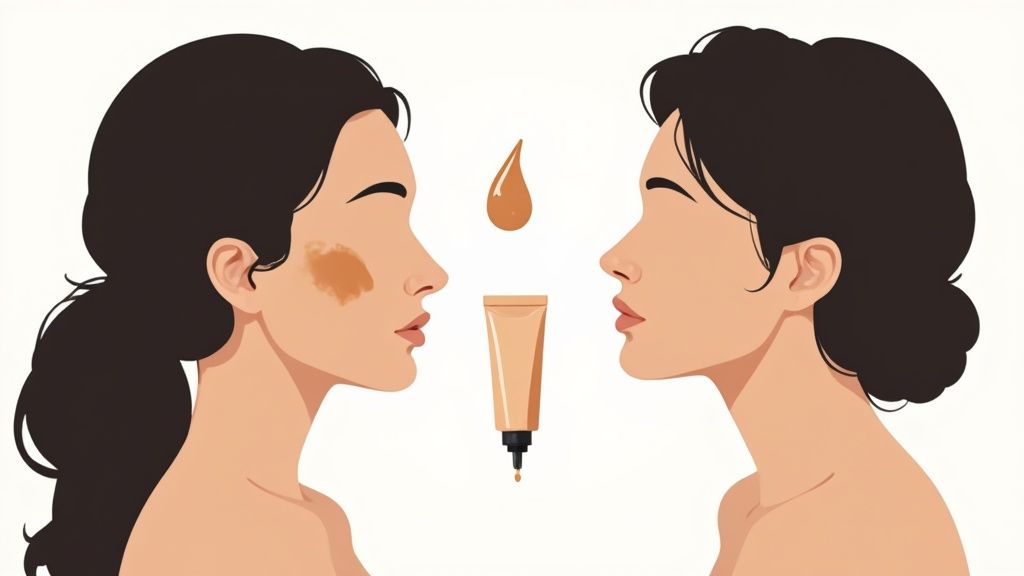
Why Your Foundation Changes Color
If oxidation is ruining your vibe, a few simple tweaks to your prep routine can make all the difference. You basically want to create a stable, neutral canvas for your foundation to sit on top of.
- Start with a Primer: A good primer acts as a barrier between your skin and your foundation, preventing your natural oils from messing with the formula and causing that dreaded color shift. A silicone-based primer is usually the most effective for this.
- Use a Setting Powder: A light dusting of translucent setting powder right after you apply your foundation can help soak up excess oil as the day goes on, stopping oxidation in its tracks.
- Blot Before You Powder: For those with extra oily skin, this is a game-changer. Use blotting papers to gently lift away excess oil before you apply your makeup. It’s a tiny step that can make a huge impact on how your foundation wears.
Adjusting for Seasonal Skin Tone Shifts
It’s completely normal for our skin tone to change with the seasons—a little deeper in the summer, a bit lighter in the winter. But that doesn't mean you have to buy a whole new bottle of foundation every six months.
Enter shade-adjusting drops. These are little bottles of concentrated pigment—in light, dark, warm, or cool tones—that you can mix directly into your foundation to get a custom color. A single drop can subtly shift your shade, giving you total control without messing up the foundation's finish or feel.
A quick, budget-friendly trick is to use a concealer that’s one or two shades lighter than your skin to brighten your winter foundation. Mix a small dot on the back of your hand before applying.
Navigating Sensitive or Acne-Prone Skin
When you have sensitive or blemish-prone skin, finding a foundation that doesn't cause irritation or breakouts can feel like a mission. The key is to look for products labeled "non-comedogenic," which is just a fancy way of saying it’s formulated to not clog your pores.
Common triggers like synthetic fragrances, certain heavy oils, and some alcohols can be the source of the problem. If you’re dealing with redness or new breakouts, try switching to a mineral-based or serum foundation, which often have shorter, cleaner ingredient lists.
This is also where tech can be a huge help. The global shade matcher market is on track to hit around USD 1.76 billion, partly because these tools are getting smarter. They can help you filter options based on your specific skin concerns, making it so much easier to find a formula that's both a perfect color match and gentle on your skin. You can read more about the rise of hyper-personalized makeup tech to see how things are changing.
Making Conscious Choices in Your Foundation Purchase
There's no better feeling than finding the one—that perfect foundation shade. But what if that discovery could also be a chance to throw your support behind brands that actually get what matters to you? The beauty industry is (finally) catching on, and making a choice that feels good inside and out is easier than it's ever been. It really just starts with knowing what you’re looking for.
When a brand claims it's cruelty-free, that should mean zero animal testing on their products or ingredients. To be sure you're not just falling for a marketing buzzword, look for the official certifications.
- Leaping Bunny: This is the international gold standard. It means the brand has proven there's no animal testing happening at any point in the process.
- PETA's Beauty Without Bunnies: Seeing this logo is another great way to confirm a brand's commitment to animal-friendly practices.
And what about vegan? For a product to be truly vegan, it can’t contain any animal-derived ingredients. Think beeswax, carmine, or lanolin. Here's a key distinction: a brand can be cruelty-free without being 100% vegan, so if both values are important to you, make sure to check for both labels.
Looking Beyond the Formula
The conversation around ethical beauty doesn't stop at the ingredient list; it extends to our planet, too. The beauty industry generates a staggering amount of packaging waste, but thankfully, a growing number of brands are starting to lead the charge toward a more sustainable, circular model.
This means a big shift toward materials that are kinder to the environment. Keep an eye out for brands using glass, aluminum, or post-consumer recycled (PCR) plastics. Even better, some companies are now offering refillable foundation systems, which is a game-changer for cutting down on single-use packaging. A great place to start your search is by exploring a list of verified sustainable beauty brands that are genuinely committed to eco-friendly practices from the inside out.
The term ‘clean beauty’ is a bit of a free-for-all. It's not regulated, so its meaning can change dramatically from one brand to the next. Instead of getting caught up in vague marketing, focus on brands that are transparent about their ingredients and avoid anything you personally know irritates your skin.
At the end of the day, a conscious purchase is simply an informed one. By seeking out trusted certifications and supporting brands with clear sustainability goals, you can find a foundation that doesn't just look amazing, but also does a little good for the planet. Your daily makeup routine can become a small but meaningful act with a positive impact.
Your Burning Foundation Questions, Answered
Even when you think you’ve got it all figured out, foundation matching can still throw a few curveballs your way. From a disappointing online purchase to a shade that mysteriously changes color, let's tackle some of the most common hurdles on the path to your perfect match.
Think of this as your go-to guide for all those tricky "what if" moments.
What if I Buy the Wrong Shade Online?
It happens to the absolute best of us. You did your homework, used the brand’s shade finder, and still, the bottle that shows up is a complete mismatch. Before you toss it, know that you have options.
- Check the Return Policy: So many brands get it, especially the ones that sell directly to you. They often have really understanding return or exchange policies because they know online matching is tough.
- Grab Some Shade-Adjusting Drops: These little potions are a game-changer. A few drops of a lightening or darkening pigment can rescue a shade that’s just a little bit off.
- Get Mixing: If it’s too dark, try mixing it with your moisturizer for a sheerer, custom-tinted look. Too light? It might just be the perfect brightening concealer for your under-eyes.
The goal here is to salvage your purchase. Sometimes a total mismatch can become your new secret weapon with a little creative chemistry.
How Do I Know if My Foundation Has Oxidized?
Ah, oxidation. It’s that super frustrating thing that happens when your foundation decides to get darker after you've had it on for a while. The biggest giveaway is when you look in the mirror an hour or two later and see a clear color difference between your face and your neck.
You’ll spot what looks like a faint orange or brownish line along your jaw that definitely wasn't there when you left the house. To avoid this disaster, always let a swatch dry down completely for at least 10-15 minutes before making your final decision.
Here's a pro tip: when you're testing in-store, swipe a swatch on your arm and then go about your shopping. If the color still looks perfect by the time you hit the checkout line, you’re probably good to go.
Should My Foundation Match My Face or My Neck?
This is the age-old foundation debate. Our faces tend to get more sun, making them a different color than our necks, which are usually a bit lighter. The real secret is to find a shade that beautifully bridges the gap between the two.
Always swatch along your jawline. The right shade will blend down into your neck so seamlessly that you can’t see where it starts or stops. You’re looking for a color that creates one harmonious, cohesive look. If you’re really struggling to find that one perfect shade, your best bet is to match your neck and then add a little warmth back to your face with bronzer.
This little trick ensures you look natural and perfectly blended from every single angle.
Can I Use the Same Foundation Shade All Year?
Honestly, for most of us, that’s a no. Our skin tone naturally shifts with the seasons—getting a bit deeper in the summer and lighter in the winter, even if you’re a sunscreen die-hard. Having a couple of "seasonal" foundations on hand can be a lifesaver.
Here’s a really practical way to handle it:
- Find your perfect match for the summer months.
- Find your perfect match for the winter.
- During those in-between seasons like spring and fall, just mix the two together! You can create a custom shade that’s exactly right for that moment.
This approach is way more budget-friendly than buying a bunch of different bottles and guarantees you’ll always have a flawless match, no matter what time of year it is.
Ready to find a foundation that loves your skin back? At Axiology, we believe in makeup that's as good for the planet as it is for your complexion. Discover our mushroom-infused Fungdation, a clean, vegan, and cruelty-free formula designed to give you a flawless, natural finish. Find your perfect match and embrace beauty with a conscience. Explore the collection at https://www.axiologybeauty.com.