The hunt for the perfect lightweight foundation for oily skin can feel like a never-ending quest. We’ve all been there—trying to find that holy grail formula that stops shine in its tracks without feeling like you’re wearing a mask. The dream is a breathable, natural matte finish that actually lasts, so you look fresh at 5 PM, not like an oil slick.
Why Finding the Right Foundation Matters
Let’s be real: the midday makeup meltdown is a genuine struggle. You’re looking for a foundation that feels like you’re wearing nothing at all but performs like it’s doing everything—controlling oil, not clogging your pores, and definitely not feeling heavy. This guide is your roadmap to finally striking that perfect balance.
We're going to skip the generic advice and get into what really makes a lightweight foundation click with oily skin. That means learning to read ingredient labels like a pro, nailing your application, and understanding why different finishes matter. It's time to say goodbye to the cakey, heavy formulas of the past and find a foundation that lets your skin breathe.
The Growing Demand for Specialized Formulas
If you’re on this quest, you’re in good company. The demand for makeup that actually works for specific skin concerns has sent the beauty industry into overdrive. The global liquid foundation market, which is full of these specialized formulas, was valued at around USD 12 billion in 2023 and is expected to jump to USD 21 billion by 2032. That's a whole lot of people looking for the same thing you are. You can dig into more of these market trends at dataintelo.com.
When you’re just starting your search, some of the most helpful insights come from leading beauty influencers. Their real-world reviews can give you a practical sense of how different products hold up on skin just like yours, helping you narrow down the options before you spend a dime.
The goal isn't just to cover up; it's to find a foundation that works with your skin. A truly great lightweight foundation for oily skin will keep excess oil in check, make pores look smaller, and feel comfortable all day long—looking just as good at the end of the day as it did when you first put it on.
Decoding the Formula for an Oily Skin Friendly Foundation
Think of the perfect foundation less like a coat of paint and more like a smart, breathable second skin. Finding the right lightweight foundation for oily skin means putting on your detective hat and looking past the pretty bottle to the ingredient list on the back. That's where the real story is.
A great formula for oily skin has two main jobs: soak up the oil you have now for an instant matte look, and help keep your skin from overproducing it later. It’s the difference between a quick fix and a long-term strategy for beating shine.
The Heroes of Oil Control
Some ingredients are absolute rockstars when it comes to managing that midday sheen. They work like tiny, invisible sponges, absorbing excess oil without ever making your skin feel tight or stripped.
When you're scanning an ingredient list, keep an eye out for these mattifying power players:
- Kaolin Clay: This is a super gentle, natural clay that's amazing at absorbing oil and gunk from your pores, leaving you with a smooth, shine-free canvas.
- Silica: Think of these as tiny, porous particles that are pros at soaking up oil and sweat. They give foundation a soft-focus, blurring effect that makes pores look way less noticeable.
- Niacinamide: This isn't just an oil-controller; it's a true skin-improving powerhouse. It can actually help regulate your skin's oil production over time while strengthening its natural barrier.
These guys work together to make sure your foundation keeps shine in check without looking flat or cakey.
The diagram below shows the usual suspects when it comes to oily skin struggles—all things a well-made foundation should tackle.
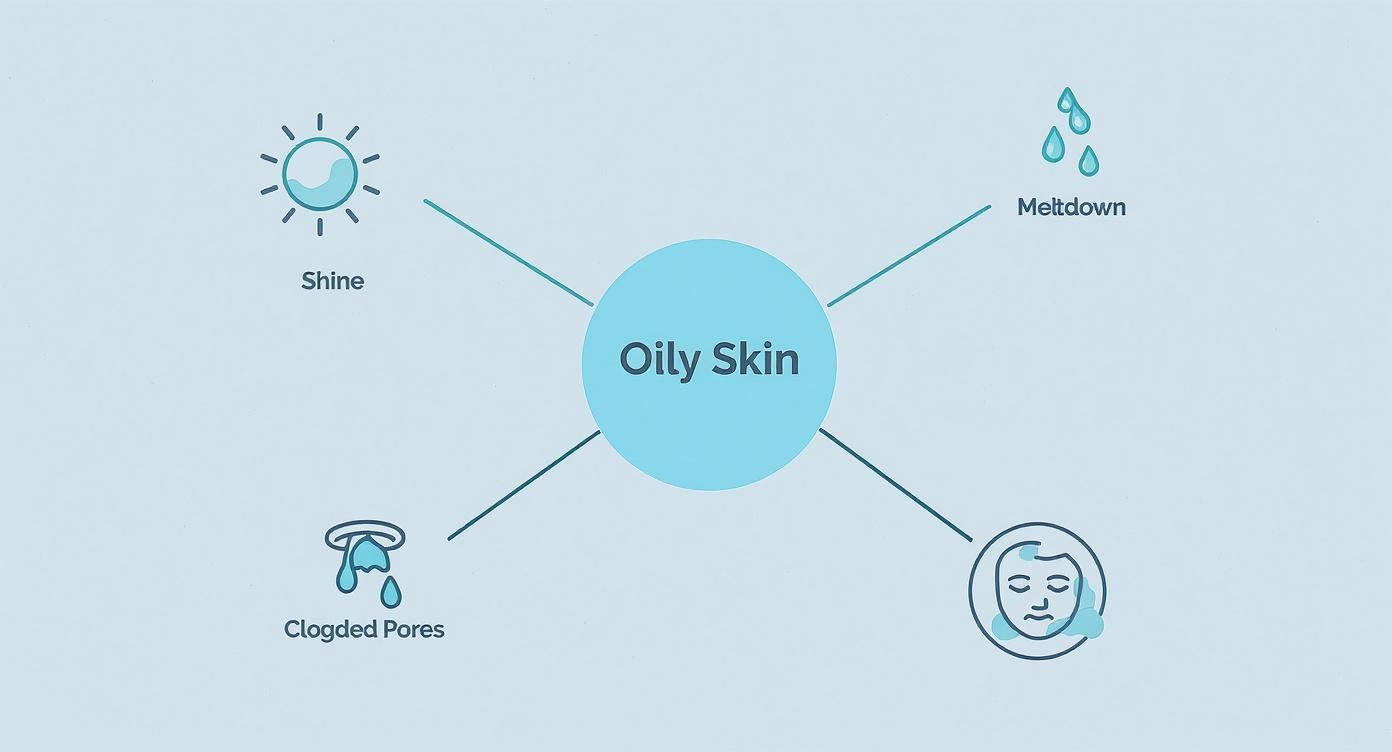
As you can see, the main culprits—shine, clogged pores, and makeup meltdown—are all connected. This is why having a foundation specifically formulated to handle them is so key.
Ingredients to Approach with Caution
Knowing what to look for is half the battle. The other half is knowing what to avoid. Some ingredients can actually make oily skin worse, leading to more shine, surprise breakouts, and that dreaded makeup separation by lunchtime.
Be wary of formulas loaded with heavy oils like coconut oil or mineral oil. While they can be moisturizing for some, they often feel greasy on oily skin and can contribute to clogged pores. The goal is to find a product that's non-comedogenic, which is just a fancy way of saying it’s formulated so it won't block your pores.
If you want to get into the nitty-gritty, our guide explains everything you need to know about non-comedogenic makeup products and why they’re a non-negotiable for breakout-prone complexions.
To make things a little easier, here’s a quick cheat sheet for your next shopping trip.
Ingredients to Seek and Avoid in Your Foundation
| Ingredient Category | Look For (The Heroes) | Be Cautious Of (The Villains) |
|---|---|---|
| Absorbers | Kaolin Clay, Silica, Rice Starch | Talc (can sometimes be irritating) |
| Oils & Emollients | Squalane, Jojoba Oil, Grapeseed Oil | Coconut Oil, Mineral Oil, Lanolin |
| Skincare Actives | Niacinamide, Salicylic Acid, Green Tea Extract | High concentrations of Alcohol, Fragrance |
| Texture & Finish | Dimethicone (for a smooth feel) | Heavy Waxes, Isopropyl Myristate |
This table isn't about good vs. evil ingredients—it's about finding what works for your specific skin type.
Learning to spot these key players is the single best tool you have for finding your holy grail foundation. It empowers you to choose a product that actively works with your skin, not against it, for a comfortable, long-lasting matte finish that feels as good as it looks.
Finding a Breathable Finish Without Sacrificing Coverage
One of the biggest myths about foundation for oily skin is that "lightweight" automatically means sheer coverage. For years, the trade-off was clear: you could either have a breathable formula that barely covered anything or a heavy, full-coverage mask that felt suffocating.
Thank goodness that’s no longer the case.
Modern formulas have completely changed the game, letting you have your cake and eat it too. Think of it like fabric. A lightweight serum foundation might be like silk—airy, breathable, and gliding over the skin with a light touch. A contemporary liquid foundation, on the other hand, can be like fine velvet, offering rich coverage that feels surprisingly weightless.
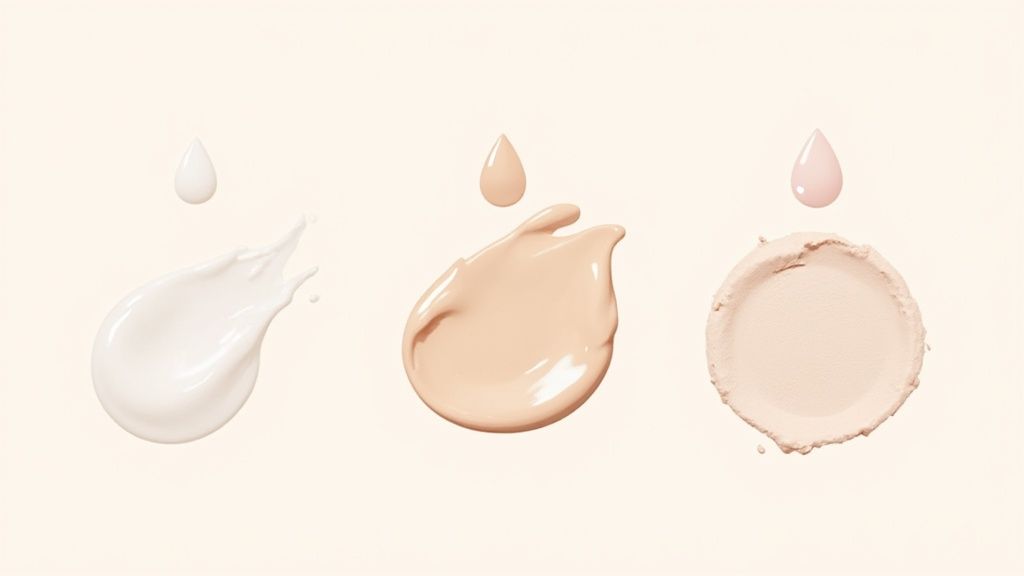
This evolution means you can choose your desired finish without compromising on comfort. You no longer have to settle for a formula that doesn't meet your coverage needs just to keep oil at bay.
Choosing Your Texture and Finish
The key to your ideal look is understanding the dance between texture, finish, and buildability. Today’s market is full of options designed specifically for us oily-skinned folks.
- Serum Foundations: These are ultra-thin and often feel more like skincare. They're perfect if you just want a light, natural tint that evens things out without feeling like makeup.
- Liquid Foundations: The most versatile of the bunch. Modern liquids for oily skin are often water or silicone-based and range from sheer to full coverage. Most are buildable, which means you can layer them for more opacity only where you need it.
- Powder Foundations: An excellent choice if your skin is extra oily. Powder foundations give a matte finish and are pros at oil absorption. You can apply them dry for lighter coverage or wet for a more traditional foundation look.
This is also where the finish comes into play. The old-school, chalky matte is out. In its place are sophisticated finishes that look way more natural.
A "soft matte" or "natural matte" finish is the new standard. It's designed to control shine and blur the look of pores while still letting your skin look like, well, healthy skin—not flat or dull.
How Modern Formulas Deliver
So, what's the secret behind these high-performing products? It's all about advanced formulation. The best lightweight foundation for oily skin options often use things like micro-powder technology and specialized shine-controlling ingredients to manage oil while keeping you looking fresh.
In fact, full-coverage oil-free liquids with climate-adaptive technology are a top choice now, with some brands offering 50 or more shades to ensure a perfect match. You can dive deeper into how these formulas are developed over at Vogue Scandinavia.
Ultimately, finding your perfect breathable finish is about finding a formula you can customize. A buildable foundation empowers you to create anything from a subtle tint to a flawless base, all while keeping your oily skin comfortable, balanced, and shine-free.
Mastering Your Application for All-Day Wear
Let's be real—even the most amazing lightweight foundation for oily skin can pull a disappearing act by lunchtime if you don't apply it just right. The secret to a flawless finish that actually lasts isn't just about the product; it's all in the prep and application. If you can build a solid, bulletproof routine, your makeup will look just as fresh at 5 PM as it did at 9 AM.
It all begins before you even unscrew the foundation cap. Think of your skin like a canvas. You wouldn't just slap paint on it without prepping it first, right? For oily complexions, that means creating a smooth, shine-free base that gives your makeup something to really cling to.
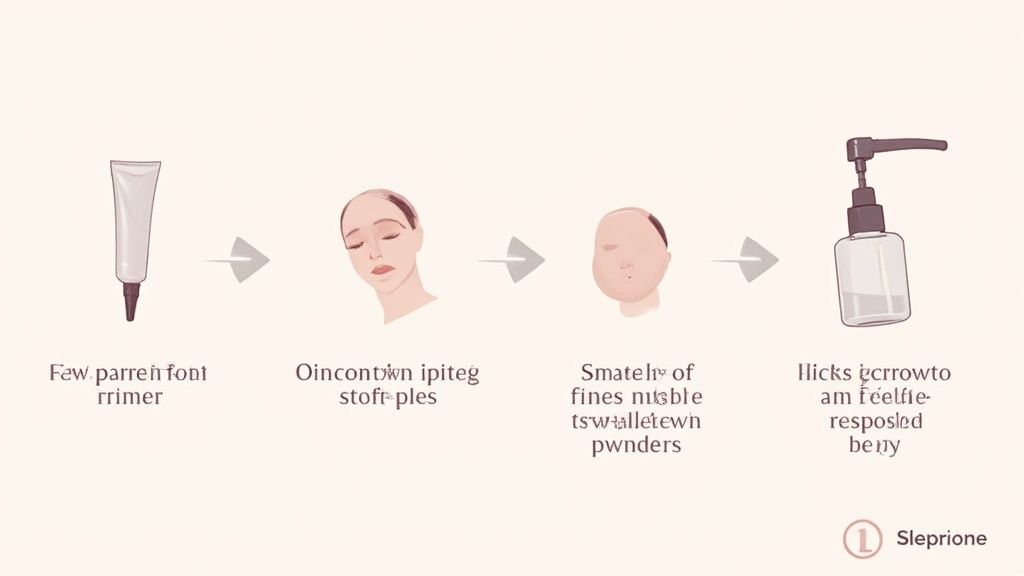
This prep work has two non-negotiable steps. First, smooth on a lightweight, non-greasy moisturizer. Hydrated skin is happy skin, and this prevents your face from overproducing oil later. Then, follow up with a mattifying primer, really focusing on your T-zone or any other personal hotspots for shine. This creates the perfect barrier between your skin’s natural oils and your foundation.
Choosing Your Tools and Techniques
With your canvas prepped, it's go-time. The tool you use can completely change the final look, and each has its own perks for oily skin.
- Damp Beauty Sponge: This is my go-to for pressing foundation into the skin for a seamless, natural vibe. The gentle tapping (or stippling) motion builds coverage without sliding that primer around.
- Foundation Brush: A dense buffing brush is awesome for getting more coverage, fast. Use soft, circular motions to work the product in and blur away the look of pores.
- Fingertips: Don't underestimate your own two hands! The warmth from your fingers helps melt the product right into your skin for an incredibly natural, second-skin finish. This is best for serum foundations or super-thin liquids.
Technique is everything. I always recommend stippling over swiping or rubbing. It deposits the product evenly without creating streaks, ensuring you get a solid layer that’s built to last. For a deep dive into all the tricks, check out our guide on how to make makeup last all day.
The final steps in your routine are what truly lock everything in place. Skipping them is like building a house without a roof—it simply won't withstand the elements.
Setting and Locking Your Look
Once your foundation is blended to perfection, you absolutely have to set it. This is probably the most critical step for anyone with oily skin. Grab a finely milled translucent powder and a fluffy brush (or a puff) and lightly press it over your foundation. This instantly soaks up any surface oil and helps the liquid set into a solid, smudge-proof finish.
And for the grand finale? A few spritzes of a mattifying setting spray. This is like hairspray for your face, creating an invisible shield over your makeup. It locks it all in and gives you an extra layer of oil control that can handle humidity, sweat, and whatever else the day throws at you.
How to Find Your Perfect Shade and Fix Common Issues
Okay, so you’ve found the perfect lightweight formula. High five! But even with the right product, a couple of hurdles can pop up: nailing your exact shade and dodging those weird application glitches.
Let's get into both, so your foundation always looks like a second skin.
Finding your shade can feel like a high-stakes guessing game, but here’s the ultimate cheat code: understand your undertone. This is the subtle hue just beneath your skin's surface—the color that’s always there, even when you get a tan.
- Cool Undertones: Your skin has hints of pink or blue. Silver jewelry probably looks amazing on you.
- Warm Undertones: You’ll notice hints of yellow, gold, or peach. Gold is likely your go-to metal.
- Neutral Undertones: You've got a mix of both cool and warm hues, so you can rock gold and silver equally well.
Once you know your undertone, shade matching gets so much easier. For a deeper dive, check out our guide on how to choose the right foundation shade for more pro tips.
Solving Common Foundation Frustrations
Even a perfect shade match can go sideways. Oily skin brings its own set of challenges, but don't worry, every single one has a fix. And you're not alone—the market for oily skin foundations was worth about USD 2.5 billion in 2023, which just shows how common these struggles are. If you're curious about the industry side of things, Dataintelo's comprehensive report has more on these trends.
Problem 1: The Dreaded Orange Tint (Oxidation)
Have you ever applied a perfect shade, only to look in the mirror an hour later and see it's turned orange? That’s oxidation. It’s a chemical reaction between your skin’s natural oils and the pigments in your foundation.
The Fix: A mattifying primer is your best friend here. It creates a barrier between your skin’s oils and your makeup. Also, keep an eye out for foundations with antioxidants like Vitamin E, which can help stop that color shift in its tracks.
Problem 2: The Midday Breakup (Separation)
This is when your foundation gets all patchy, separating and settling into pores and fine lines. It usually happens when your skincare underneath is too rich or oil-based, creating a surface that’s too slippery for your makeup to grab onto.
The Fix: Go for a lightweight, oil-free moisturizer and—this is key—let it fully sink in for a few minutes before you even think about primer or foundation. This gives your makeup a stable base to cling to, preventing it from sliding around and separating as the day goes on.
Your Questions, Answered
Let's be real, trying to find the right foundation when you have oily skin can feel like a full-time job. It brings up a lot of questions. Here are the quick-and-dirty answers to some of the ones we get asked most often.
Can I Use a Lightweight Foundation if I Have Acne?
You absolutely can. In fact, it might be exactly what your skin is craving. Many modern lightweight foundations are formulated to be non-comedogenic, which is just a fancy way of saying they won’t clog your pores—a total game-changer for acne-prone skin.
The trick is to look for oil-free formulas and maybe even some with skin-friendly ingredients like salicylic acid for an extra boost. A buildable formula is your best friend here. It lets you add a little extra coverage right where you need it (hello, surprise blemishes) while letting the rest of your skin breathe.
How Do I Keep My Foundation From Looking Cakey?
Ah, the dreaded cake-face. We’ve all been there. It’s usually caused by one of two things: piling on too much product at once, or applying foundation over dehydrated skin.
To dodge the cakey look, start with a tiny amount of foundation and build it up in super-thin layers. And don’t skip the prep! Make sure your skin is happy and hydrated with a good lightweight, oil-free moisturizer first. For a truly seamless finish, try pressing the foundation into your skin with a damp beauty sponge. A final, light dusting of a finely milled translucent powder can set everything without adding any bulk.
My rule of thumb is always "less is more." You can always add another sheer layer, but it's a real pain to take foundation away once you've gone too heavy.
Is Powder or Liquid Foundation Better for Oily Skin?
Honestly, one isn't definitively "better" than the other. They just do different jobs and give you different results.
- Powder foundations are amazing at soaking up oil and giving a consistently matte look. They're a great go-to for super oily skin or for quick touch-ups when you're out and about.
- Lightweight liquid foundations, on the other hand, usually deliver a more natural, skin-like finish. When you prep your skin and set them right, they can have some serious staying power.
At the end of the day, the best lightweight foundation for oily skin really boils down to what you prefer. It's all about the coverage and finish you're going for.
Ready to find a foundation that feels more like skincare? Check out Axiology's innovative, mushroom-infused Fungdation. It’s a breathable, skin-renewing finish that actually loves your skin back. Shop now at axiologybeauty.com.