Let's be real: finding the perfect concealer shade is the secret to that flawless, natural-looking finish we’re all chasing. It really comes down to understanding your skin’s unique undertone and knowing what you need the concealer to do—is it for brightening up dark circles or making a blemish disappear? Nail this skill, and you’ll always look refreshed and confident.
Your Journey to Finding the Perfect Concealer Shade

Trying to find "the one" can feel like a mission, but it doesn't have to be. Forget the generic advice you’ve heard before. We're going to break down how to choose the right shade by focusing on what actually matters, giving you a clear path to your perfect match.
A Conscious Approach to Flawless Skin
For those of us who love beauty but also care about the planet, this journey is about more than just looking good. When you find your perfect match, you actually use less product and create less waste. It’s a huge step toward a more sustainable routine.
Think about it: when a shade truly works for you, you'll use every last drop instead of tossing a half-full tube in the trash. This is especially true if you’re into clean beauty and want to know more about what is vegan makeup and how it helps both your skin and the environment.
This mindset is so important, especially when you consider the global concealer market is worth around USD 8.64 billion. That number is expected to climb to over USD 13.6 billion by 2032, all because we're demanding formulas that really work. You can dig into more stats on this growing market over at Dataintelo.com.
Since concealers are often used on high-contrast areas like under the eyes, being even one shade off is super noticeable. That often leads to returns and, you guessed it, more waste.
Choosing your shade with intention isn't just a beauty hack; it's a sustainable practice. By investing a little time upfront, you contribute to reducing waste in a multi-billion dollar industry.
Ultimately, learning how to pick the right concealer benefits both your look and your values. You’ll feel amazing when you find a shade that blends seamlessly, all while supporting brands that align with a planet-friendly lifestyle. Let’s get you to your perfect, conscious concealer match.
How to Confidently Identify Your Skin's Undertone
Before we even get into picking a concealer, we need to talk about your skin's unique color profile. This is the step where so many of us get tripped up and end up with a shade that just looks… off.
The secret is your skin’s undertone—that subtle, natural color that lives just beneath the surface. It’s the key to finding a concealer that truly melts into your skin, rather than sitting on top of it.
Your surface tone might change with a bit of sun or a passing breakout, but your undertone is constant. Nailing this down is the single best way to avoid concealers that look ashy, too orange, or just plain wrong.
The Vein Test: A Classic for a Reason
One of the quickest and most reliable ways to get a read on your undertone is the good old vein test. It's super simple: just find some natural daylight and take a peek at the veins on the inside of your wrist.
- If your veins look mostly bluish or purple, you likely have a cool undertone. Your skin probably has hints of pink, red, or blue.
- See more greenish or olive veins? That suggests a warm undertone. Your skin likely has golden, peachy, or yellow hues.
- If you’re squinting and honestly can't decide—seeing a mix of both blue and green—you probably have a neutral undertone. This means you've got a nice balance of cool and warm tones.
This little check gives you a fantastic starting point for figuring out which shade family is yours.
The Jewelry and Clothing Test
Another really practical way to figure this out is to see how your skin vibes with different metals and colors. Think about the jewelry that makes your skin look its most radiant and alive.
Does silver, platinum, or rose gold jewelry really make your skin pop? If so, you're probably in the cool undertone family. But if gold jewelry is your absolute best look, you’re likely in the warm undertone camp. And if you can rock both without one looking obviously better? Hello, neutral!
You can apply the same logic to your wardrobe. People with cool tones often look incredible in blues, purples, and emerald greens, while those with warm tones truly shine in earthy shades like orange, yellow, and olive.
Pro Tip: Your undertone is a huge player in selecting all of your makeup. Getting this right for your concealer will make it so much easier when you learn how to choose the right foundation shade for a truly seamless look.
How Your Skin Reacts to the Sun
Think about your skin's relationship with the sun. When you spend a day outside, does it tend to turn pink and burn, or does it tan to a golden-brown?
- If you burn easily and don’t really tan, you probably have a cool undertone.
- If you tan easily and rarely burn, your undertone is almost certainly warm.
- And if you sometimes burn, but it eventually fades into a tan? You might just have a neutral undertone.
To make it even easier, here's a quick cheat sheet to compare the common signs of each undertone at a glance.
A Quick Guide to Identifying Your Undertone
| Characteristic | Cool Undertone | Warm Undertone | Neutral Undertone |
|---|---|---|---|
| Veins on Wrist | Blue or purple | Green or olive | A mix of blue and green |
| Best Jewelry | Silver, platinum, rose gold | Gold | Both look great |
| Reaction to Sun | Burns easily, rarely tans | Tans easily, rarely burns | Burns then tans |
| Flattering Colors | Blues, purples, jewel tones | Oranges, yellows, olive green | Most colors work well |
Pinpointing your undertone is truly the most important part of finding your perfect concealer. Once you know if you're cool, warm, or neutral, you can filter your options with confidence and find a shade that enhances your natural complexion instead of just covering it up.
Matching Your Concealer to Its Specific Mission
Think of your concealer like a specialist you call in for a specific job. You wouldn't use the same tool for every task around the house, and the same logic applies here. The real secret to a flawless finish isn't just finding a concealer, but finding the right concealer for the mission at hand.
A concealer meant to brighten up tired under-eyes has a totally different goal than one designed to make a blemish vanish. Nailing this distinction is pretty much the key to mastering your whole look.
Shades for Brightening and Lifting
When you want to tackle dark circles and give your face a lifted, more awake look, you have to go lighter. The rule of thumb I always follow is to pick a concealer that's one to two shades lighter than my skin tone or foundation.
This slight difference is what creates that beautiful, highlighting effect. It catches the light just right, drawing attention upward and making you look like you got a full eight hours of sleep. For those stubborn blue or purple tones under the eyes, a concealer with a hint of peach or pink is a game-changer—it cancels out the darkness before it brightens.
The goal for under-eyes isn't a perfect match; it's about color correction and illumination. A shade that's too close to your skin tone will just cover the area without providing that essential lift.
Shades for Spot Concealing
Now, covering blemishes, redness, or dark spots is a whole different ball game. The mission here is pure camouflage. You want that spot to completely disappear into the background. If you use a lighter shade on a pimple, you're basically putting a tiny spotlight on it—exactly what you don't want to do.
For spot concealing, your concealer needs to be an exact match to your skin tone and foundation. The idea is for it to blend so seamlessly that the blemish becomes invisible. This is where getting your undertone right is non-negotiable.
The Role of Color Correctors
Sometimes, a standard concealer just isn't enough to handle intense discoloration. That's when you bring in the big guns: color correctors.
- Green: This is your go-to for neutralizing angry red blemishes or rosacea. Just a sheer layer underneath your regular concealer does the trick.
- Peach/Orange: Works wonders to cancel out deep blue or purple dark circles, especially on medium to deep skin tones.
- Yellow: A great option for brightening up dullness and counteracting purple hues on fairer skin.
This first step—figuring out your undertone—guides every other choice you make. This little chart is a super helpful way to get started.
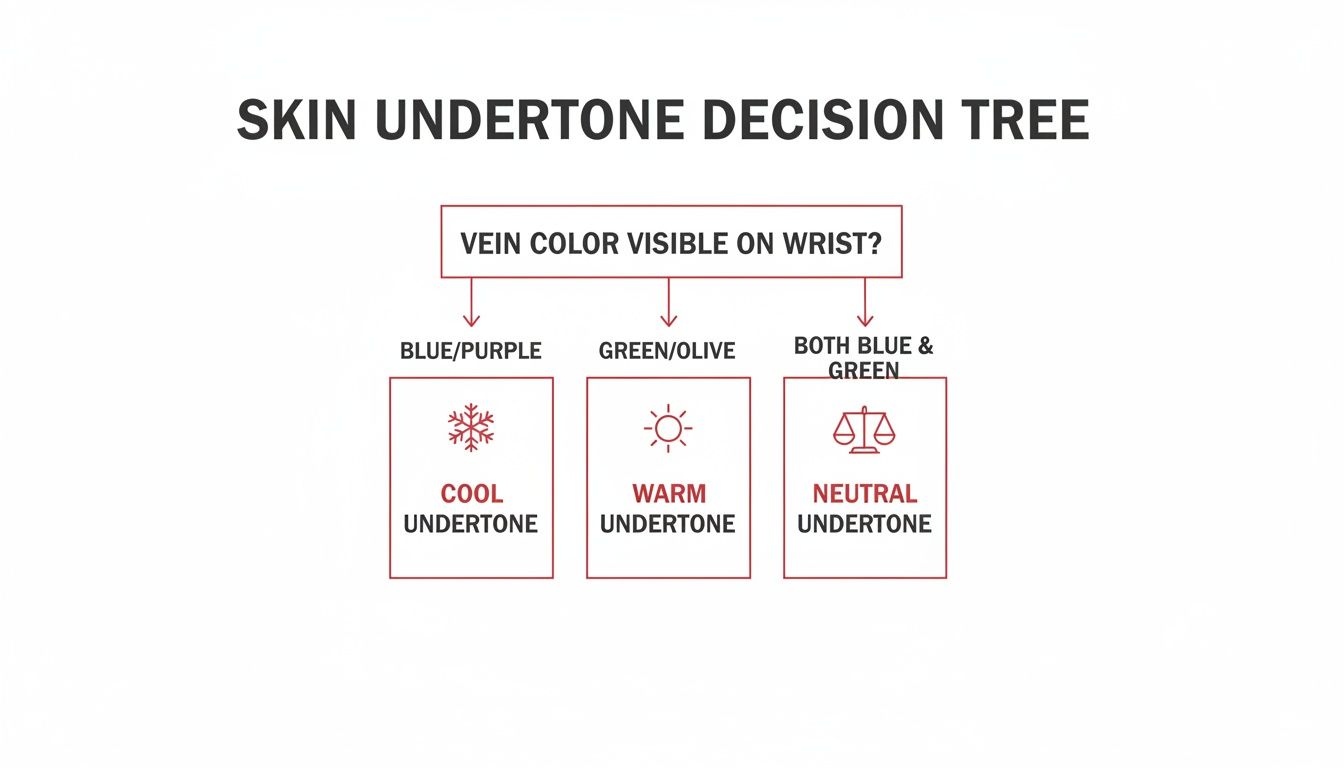
Just a quick glance at your veins can give you a major clue about whether you should be looking for cool, warm, or neutral undertones in your products. It's a simple trick, but it makes a huge difference. Sticking to the "one shade lighter for brightening" or "exact match for spots" rule really cuts down on those frustrating mismatches. If you want to dive deeper, you can discover more insights about how clear labeling impacts the market for correctors.
The Art of Swatching for a Perfect Match

We've all been there. Swatching seems simple enough, but getting it wrong is probably the biggest reason we end up with a shade that just doesn't work. The classic mistake? Testing concealer on the back of your hand or wrist. It's convenient, I get it, but the skin there is often a totally different tone and texture than your face. This almost always leads to a shade that looks off right where you need it most.
To really nail your shade, you have to test it in the right spot. And that spot depends entirely on what you want your concealer to do.
Where to Swatch for Different Needs
If you're looking for an all-over concealer to cover redness or blemishes, the best place to swatch is directly on your jawline or the side of your cheek. This area gives you the most honest look at your facial skin tone, making sure the product will blend in seamlessly when you need it to cover an imperfection.
But if you’re on the hunt for a good under-eye brightener, try applying a small dot just beside the outer corner of your eye, blending it a bit downward. This little trick lets you see if the shade actually lifts and brightens that area without looking weirdly light or ashy against your natural complexion.
A perfect swatch is one that disappears. Apply two or three promising shades in small stripes, gently blend the edges, and see which one becomes virtually invisible against your skin.
The Impact of Lighting and Oxidation
Let's be real: store lighting is a trap. Those bright, artificial lights are designed to make everything look good, but they can completely change how a shade looks on your skin. Whenever you can, check your swatches in natural daylight. Seriously, just step outside or find a window to see the truest color.
There’s another sneaky factor at play: oxidation. This is when a concealer’s color deepens as it dries and mixes with the air and the oils on your skin. What looks like a perfect match in the first few seconds can turn a shade or two darker within minutes.
This is where a little patience makes all the difference. After you've applied your test swatches, don't make a snap decision.
- Wait and Watch: Give the swatches at least ten to fifteen minutes to completely dry down and settle.
- Step Outside: Once the concealer has set, grab a mirror and find a spot with good natural light.
- Assess the Blend: Check to see which shade has melted into your skin the best. The right one will look like you're not wearing anything at all.
This patient approach is the secret to avoiding that "why did I buy this?" feeling later. Taking the time to test properly means you'll bring home a product you actually love and use to the very last drop—a win for your makeup routine and for your goal of reducing waste.
Choosing Your Formula for a Clean Conscious Application
Okay, you’ve found your perfect shade. That’s a huge win, but it’s really only half the story. The right color needs an amazing formula to back it up, especially when you’re looking for a clean, conscious product that feels as good as it looks.
Think of it this way: your concealer’s formula dictates everything. It determines the coverage, the finish, and how it’ll play with your skin all day long.
A concealer is more than just pigment—it's basically a skincare-makeup hybrid that you’re putting on some of the most delicate skin on your face. Because of this, picking a formula loaded with skin-loving ingredients is a total non-negotiable.
For example, our Fungdation is infused with reishi and snow mushrooms, which are known for their renewing properties. This kind of thoughtful formulation means your concealer is actively working with your skin, not just sitting on top of it. When you choose a non-toxic concealer, you get to cover and brighten without ever having to worry about questionable additives.
Finding a Formula for Your Skin Type
The texture of your concealer should feel like it was made for your skin. If your skin is on the drier side or is more mature, a creamy, hydrating formula is your best friend—it’ll help prevent creasing while adding a welcome bit of moisture. On the flip side, if you have oily skin, you’ll probably love a more natural matte finish that stays put.
- For Dry Skin: Look for hydrating ingredients like rich butters and oils that give you a dewy, moisturizing finish.
- For Oily Skin: Seek out formulas that offer a self-setting or matte finish to keep shine in check and provide coverage that lasts.
- For Sensitive Skin: Stick with clean, minimal-ingredient lists and soothing botanicals to keep irritation at bay.
And when you opt for a plastic-free, vegan product, you’re extending that mindful approach even further. It’s proof that you never have to sacrifice performance for products that are kind to animals and our planet.
Inclusivity and Conscious Choices
This commitment to smart formulation naturally extends to shade inclusivity. The demand for a diverse range of shades is a powerful force in the beauty world—the shade-inclusive cosmetics market is projected to hit USD 51.7 billion by 2035.
For sustainable brands like us, offering a well-curated shade range isn't just about meeting market demand. It’s also about our core value of reducing waste from mismatched returns.
By choosing a brand that values clean ingredients and inclusive shades, you're making a conscious decision. You're supporting a better beauty ecosystem where performance, ethics, and planetary health go hand-in-hand.
Ultimately, figuring out the whole concealer how to choose shade thing is about the complete package: the color, the formula, and the values behind the product. When you get all three to align, you end up with a flawless finish that feels true to you.
Common Questions About Choosing a Concealer Shade
Even when you think you’ve got it all figured out, a few questions always seem to pop up in the middle of a concealer hunt. It’s totally normal. Let’s clear up some of the trickiest scenarios people run into.
Can I Just Use My Foundation Shade as My Concealer?
It's a super common question, and honestly, it really depends on what you're trying to do.
If you’re covering up blemishes or a bit of redness, using a concealer that’s an exact match to your foundation is the way to go. This makes the spot just disappear into your skin without calling any attention to it.
But for that bright, awake look under your eyes? Your foundation shade just isn't going to cut it. It might cover the darkness, but it won’t give you that pop of light. That’s a job for a dedicated brightening concealer.
Think of them as a team: foundation creates your even-toned canvas, while concealer is for targeted, specific fixes right where you need them. Different jobs, but they work together beautifully.
Why Does My Under-Eye Concealer Look Gray or Ashy?
Ugh, this is the worst, and it’s almost always an undertone issue. When your concealer turns gray or ashy, it’s a dead giveaway that the shade is either too cool-toned or just plain too light for the darkness you’re trying to cover.
When you put a light, cool shade over purplish or blue under-eye circles, it doesn't have the warmth needed to actually cancel out that discoloration. So instead of brightening, you get this dull, chalky effect that somehow makes you look even more tired.
Luckily, the fix is pretty simple:
- Bring in the Warmth: Look for a concealer with a peachy, pink, or warm undertone. These colors are on the opposite side of the color wheel from blue and purple, so they literally neutralize the darkness.
- Go One Shade Lighter: The shade itself should only be about one (maybe two, tops) shades lighter than your skin. This gives you that brightening boost after the warm undertone has done the heavy lifting.
How Can I Choose a Concealer Shade Online?
Shopping for concealer online feels a lot less like a gamble these days, but you still have to be smart about it. With the right strategy, you can totally find your perfect match without leaving the house.
First off, use the digital tools brands offer. So many sites have virtual try-on features or detailed quizzes that recommend a match based on your photos or answers. It’s also a game-changer to look for swatch photos on real people with a bunch of different skin tones.
You can also cross-reference shades with a foundation or concealer you already own and love. Websites like Findation are brilliant for this—you just plug in a shade that works for you, and it spits out the equivalent in another brand. It's a great starting point.
For the eco-conscious shopper, the best move is to find brands that offer samples. This is hands-down the most sustainable way to test-drive a shade. You get to see how it looks in your own lighting with zero commitment and minimal product waste. Trying a sample first means you can buy the full-size product knowing you’ll love and use every last drop.
Ready to find your perfect, skin-loving match? Explore Axiology's collection of clean, vegan, and plastic-free makeup to discover a flawless finish that aligns with your values. Find your shade at https://www.axiologybeauty.com.