Walking into the foundation aisle can feel like you're about to take a high-stakes exam. There are countless bottles, tubes, and powders all promising a perfect complexion. But here's the secret: the best foundation isn't some universal miracle product. It's a personal choice that comes down to your unique skin type, the coverage you want, and the finish you love.
Think of this guide as your personal map to navigating all those options with total confidence.
Your Guide to Navigating the World of Foundation
Finding the right foundation can feel overwhelming, but it really doesn't have to be. The goal isn't to find a single "best" product, but to build a small, curated wardrobe for your skin. You wouldn't wear a heavy winter coat in July, right? Same idea. You probably don't want a heavy, full-coverage foundation for a casual weekend brunch.
This sheer variety is a huge reason the global cosmetics foundation market is absolutely booming. It was valued at around USD 4.24 billion in 2023 and is expected to jump to USD 7.39 billion by 2032. That growth is fueled by the incredible diversity of liquid, powder, cream, and stick formulas that cater to every possible skin need out there. You can learn more about these cosmetic market trends and what's driving them.
Understanding the Core Factors
Before you even think about specific products, let's nail down the three pillars of foundation selection. These are the key elements that work together to determine how a product will look, feel, and wear on your skin all day long.
- Skin Type: Are you oily, dry, combination, or sensitive? This is your starting point. It dictates whether you need something hydrating, mattifying, or super gentle.
- Coverage Level: This is all about how much pigment is in the formula. Do you want a sheer wash of color that lets your freckles peek through, or are you looking for a flawless canvas?
- Finish: This describes the final look on your skin. Finishes range all the way from dewy and radiant to a soft satin or completely matte.
This little diagram breaks down how your skin's needs branch out into these key decision-making factors.
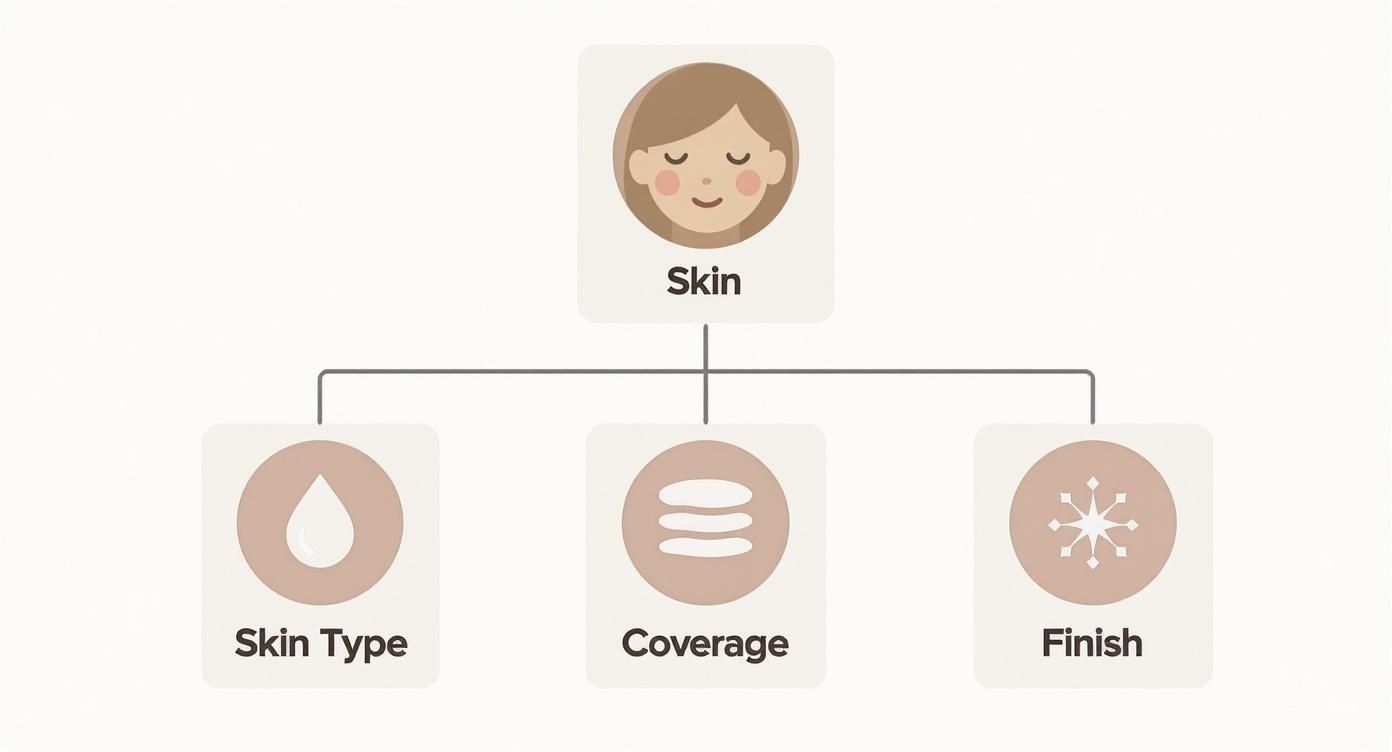
It really shows that your choice is a cascade of personal preferences. It all starts with your skin's natural characteristics and flows right into the final look you're hoping to achieve.
The Classics: Liquid and Cream Foundations
When you think about foundation, chances are you're picturing a liquid or a cream. These two are the undisputed classics, the most popular kids on the block for a reason. They're like the perfect white t-shirt and jeans of your makeup collection—totally reliable, super versatile, and there's a style out there for pretty much everyone.
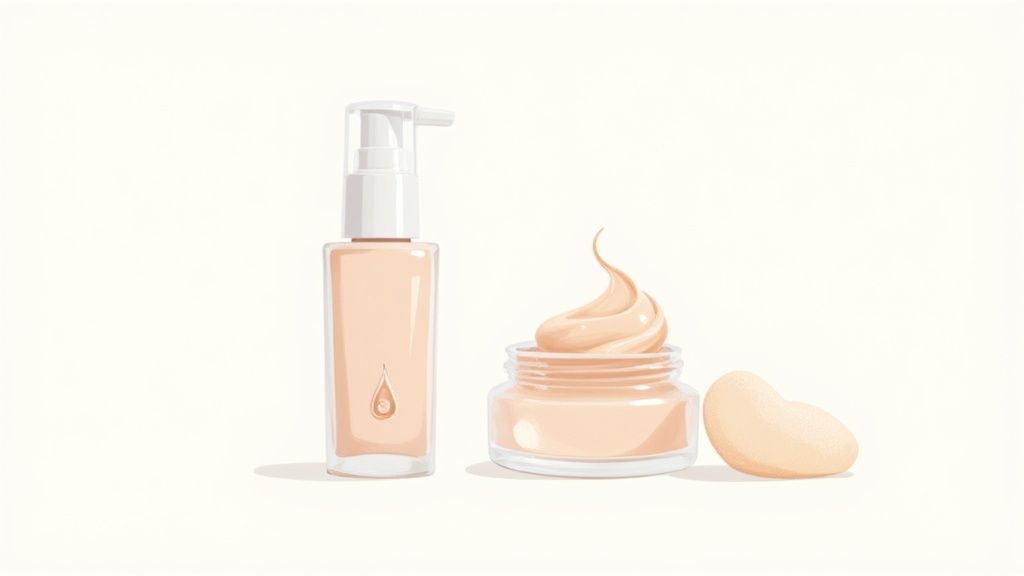
Liquid foundations are the ultimate chameleons of the beauty world. Their secret is in the base, which is usually water, silicone, or oil. This single ingredient changes everything, from how it feels to how it looks on your skin. A water-based formula, for example, feels light and almost refreshing, making it a fantastic pick if you have oily or acne-prone skin and crave coverage that won't feel heavy or smothering.
Then you have silicone-based liquids, which give you that signature silky, gliding feeling. They smooth over the skin, blurring out fine lines and pores for an effect that’s almost like a real-life filter. These are the ones you reach for when you need your makeup to last, making them perfect for big events or those days that stretch from morning to late night.
What Makes Liquid Foundation So Versatile?
The real magic of liquid foundation is how much control you have. You can sheer it out with your fingertips for that "my skin but better" vibe, or grab a brush or sponge and build it up for a completely flawless, full-coverage finish. This flexibility is exactly why it’s loved by everyone from total makeup newbies to seasoned pros.
- Best for Skin Types: Pretty much everyone, just match the base to your needs (e.g., water-based for oily, oil-based for dry).
- Coverage Range: Sheer to full. It’s all about how you build it.
- Common Finishes: Dewy, satin, natural, and matte. You name it, there's a liquid for it.
Here's the key takeaway for liquids: always match the formula's base to what your skin is asking for. If you're fighting shine, an oil-free, water-based foundation is your best friend. If your skin is thirsty, a hydrating formula with oils will give you that gorgeous, radiant glow.
The Cozy Comfort of Cream Foundations
If liquid foundations are the versatile workhorses, then cream foundations are the luxurious cashmere sweaters of makeup. Their texture is richer, thicker, and packed with moisture, which is a total game-changer if you have dry or mature skin.
Creams are loaded with a higher concentration of both pigment and hydrating ingredients. This potent combination does two things beautifully: it provides incredible coverage that knocks out redness and discoloration, and it plumps the skin with moisture. The result is a smooth, radiant finish that glides over fine lines instead of settling into them. For anyone looking for comfort and a youthful glow, cream is the way to go.
And they’re so easy to use. Just warm a little between your fingertips and press it into the skin—it will melt in seamlessly. For more targeted coverage, a dense brush will buff it out perfectly. Plus, that creamy texture makes them amazing for quick touch-ups on the go.
Powder and Stick Foundations Are Total Game-Changers
Alright, let's move past the classic bottles and jars. Powder and stick foundations are two formats that often get overlooked, but honestly, they can be the secret weapon in your makeup bag. They're especially brilliant when you need something that performs a specific job or you're just short on time. They prove that the best foundation for you might not be a liquid at all.
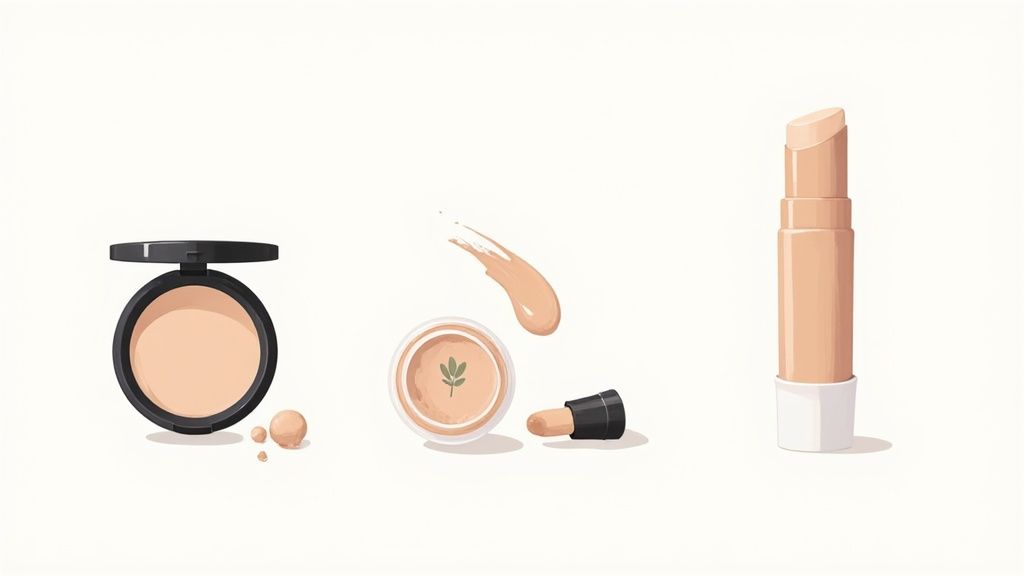
If you spend your days fighting off shine, powder foundation is about to become your new best friend. It’s literally designed to soak up excess oil and leave you with a soft, matte finish that actually lasts. While liquids are amazing, market trends show that powders have become wildly popular, particularly for oily skin types, because they're just so good at keeping that midday slickness at bay. You can dig into the cosmetics foundation market trends to see just how much people are loving them.
In the powder world, you've got two main players, and each one brings something different to the table.
Pressed Powder for On-the-Go Perfection
Think of pressed powder as your portable blotting paper, but way better because it adds coverage. It’s a super fine powder packed into a compact, making it an absolute must-have for quick touch-ups when you're out and about.
- Best For: Normal, combination, and especially oily skin.
- Application: Grab a dense kabuki brush if you want more coverage, or use a big fluffy powder brush for a lighter, setting effect. A sponge is great for targeting specific spots.
- Benefit: Its mattifying power is perfect for setting liquid or cream foundations and knocking back shine throughout the day. It’s an essential for a polished look that stays put.
One of the best-kept secrets about pressed powder is its ability to instantly blur the look of pores. A quick dusting over your T-zone can give you a smoother, more refined texture without caking on another heavy layer.
Loose Powder for a Natural, Airy Finish
Loose mineral powder is all about breathable, buildable coverage that feels like absolutely nothing on your skin. It’s made from finely milled minerals, which is why it’s often the top pick for sensitive or acne-prone skin—these formulas are usually free of common irritants like oils, synthetic fragrances, and preservatives.
Buffing a loose mineral powder into the skin with a dense brush creates this gorgeous, soft-focus effect. It evens out your complexion but still lets your real skin show through. It's the ultimate choice for that "no-makeup" makeup vibe that still gives you the coverage you want.
Stick Foundations: The Ultimate in Convenience
Stick foundations are the Swiss Army knives of the makeup world. Seriously. These super-pigmented, creamy formulas come in a simple twist-up stick, which makes them incredibly versatile and a dream for travel.
Because they're solid, you can be incredibly precise. Just swipe it right onto your skin and blend it out with your fingers, a sponge, or a brush for a full face in seconds. It also moonlights as a concealer for covering blemishes or dark circles. Want to contour? Just grab a darker shade. This multi-tasking magic makes it a true hero for anyone looking to simplify their routine.
Lighter Options for a Natural Look
Let's be real: not every day is a full-coverage foundation day. Sometimes you just want to look like yourself, but maybe a version that got a solid eight hours of sleep. For those times, a whole different category of base makeup comes into play—lighter formulas that are practically skincare. These products are the beautiful middle ground, enhancing your skin instead of hiding it.
We're talking about tinted moisturizers, BB creams, and CC creams. They might all seem like the same thing, but each one has a slightly different job to do when it comes to getting that easy, everyday glow. Figuring out which one is for you just depends on what your skin is asking for that day.
Tinted Moisturizers for a Hint of Hydration
Think of a tinted moisturizer as your go-to daily lotion, but with a little whisper of color. It’s the most straightforward of the bunch. Its main gig is to hydrate, with the added bonus of a sheer tint that just barely evens things out.
This is your secret weapon for the ultimate "no-makeup" makeup look. It’s not going to cover major breakouts, but it will leave your skin looking fresh and dewy. Perfect for running errands or those days you want to feel a little polished without any fuss.
A great tinted moisturizer is like a soft, flattering filter for your face in real life. It smooths everything out just enough while letting your real skin texture and freckles peek through.
BB Creams: The All-in-One Overachiever
Next in the lineup is the BB cream, short for "Blemish Balm" or "Beauty Balm." These came to us from Asia and are true workhorses, packing a ton of skincare benefits into one little tube. They offer a bit more coverage than a tinted moisturizer but still feel way lighter than a classic foundation.
A good BB cream is basically a whole routine in one step:
- Light Coverage: To blur minor spots and even out your skin tone.
- Hydration: Moisturizing ingredients so your skin feels comfy all day.
- SPF: Sun protection is almost always part of the deal.
- Antioxidants: To help shield your skin from pollution and other environmental yuck.
If you’re on the hunt for the best lightweight foundation to simplify your mornings, a BB cream is a fantastic place to start. It gives you that healthy, glowy finish that’s just right for everyday life.
CC Creams: The Targeted Problem-Solver
Last but not least, we have the CC cream, or "Color Corrector." This one is the problem-solver of the group. It also offers light coverage and skincare goodies like a BB cream, but its main mission is to tackle discoloration head-on.
CC creams are packed with light-diffusing particles and special pigments that are specifically designed to cancel out things like redness, sallowness, or dullness. If you deal with blotchy or uneven skin, a CC cream creates a perfectly uniform canvas. It’s like getting a color-correcting primer and a light foundation in a single, easy step.
Diving Into Some Different Formulas
Okay, so we've covered the classic liquids and powders. But the foundation world has gotten so much more interesting, with cool new formulas popping up to solve very specific skin issues. It really shows how personal finding the right foundation has become, with options for everything from super-sensitive skin to the need for a perfect face on the go.
If you have reactive skin, mineral foundations are basically a safe haven. They're made from finely milled, natural minerals—think things like mica, zinc oxide, and titanium dioxide. The real magic is what they don’t have. You usually won't find potential troublemakers like oils, waxes, synthetic fragrances, or preservatives.
This “less is more” approach makes them incredibly gentle and lets your skin breathe. Instead of creating a heavy layer that can trap oil and bacteria, mineral powders work with your skin, which is why they're a top pick for anyone dealing with sensitivity, acne, or rosacea.
The Rise of Cushion Compacts
And then there are cushion foundations, a game-changing idea that came out of South Korea and completely took over. Picture this: a squishy, porous sponge soaked in a super lightweight, almost serum-like foundation, all tucked into a sleek little compact. This isn't just clever packaging; it's a totally different way to apply your makeup.
The whole cushion system gives you amazing control over your application. You just press the little puff applicator onto the sponge to pick up a bit of product, and then gently tap—or "stamp"—it onto your skin.
This tapping method is kind of brilliant for a few reasons:
- It blends itself: The tapping motion just melts the foundation into your skin, so you don't get those annoying streaks.
- You control the coverage: It’s so easy to add another light layer just where you need it, without ever looking cakey.
- Clean and portable: The compact is perfect for touch-ups, and the applicator means you’re not dipping your fingers into the product.
Cushion foundations are the secret to getting that fresh, dewy, natural-looking skin in seconds. They give you the hydrating, barely-there feel of a liquid with the grab-and-go convenience of a powder compact.
These specialty formulas are proof that there really is a perfect match for everyone. Whether your main goal is to calm your sensitive skin with a pure mineral formula or get a flawless glow during your morning commute with a cushion compact, the right product is definitely out there. It’s just a matter of figuring out what your skin really needs and exploring the options that get it.
How to Choose Your Perfect Foundation Match
Alright, you've made it through the jungle of foundation formulas. Now for the fun part: putting it all together to find your perfect match. Don’t worry, this isn’t about random guessing. It’s a simple, three-part puzzle that puts you completely in charge.
First up, you have to get real about your skin type. Is it oily, dry, a bit of both, or super sensitive? This is your most important clue. It immediately tells you which formulas—like a hydrating cream or a shine-busting powder—are going to be your best friend, not your enemy.
Next, think about the look you’re going for. What’s the vibe? A sheer, dewy glow for everyday coffee runs, or are you after a full-coverage, satin finish for a big night out? Nailing this down helps cut through the noise and narrow your options in a major way.
Nailing the Perfect Shade
Finally, it’s all about the color. Finding the right shade isn't just about light or dark; it's about matching your skin's undertone—that subtle hue just beneath the surface. This is the secret to a foundation that looks like a second skin, not a mask.
- Cool Undertones: Your skin has hints of pink, red, or blue. The sun is not your friend, and you tend to burn.
- Warm Undertones: Your skin leans golden, peachy, or yellow. You probably tan like a champ.
- Neutral Undertones: You’ve got a mix of both cool and warm hues. Lucky you!
The easiest trick in the book is the vein test. Just peek at the veins on your wrist in natural light. If they look blue or purple, you’re cool-toned. If they seem greenish, you’re warm-toned. See a little of both? That’s a sign you’re neutral.
Choosing the right shade online can feel like a shot in the dark, but our detailed https://axiologybeauty.com/blogs/our-blog/foundation-shade-finder is designed to walk you through it with confidence. And if you’re hungry for even more great advice, you can always discover more foundation tips from other experts.
Your Foundation Decision Checklist
Feeling a little overwhelmed? Let's break it down. Use this quick checklist to guide your thinking and point you toward the right formulas.
| Consideration | Your Choice | Recommended Foundation Types |
|---|---|---|
| 1. My Skin Type Is... | (e.g., Oily, Dry, Combo, Sensitive) | Liquid, Cream, Powder, Mineral |
| 2. I Want Coverage That Is... | (e.g., Sheer, Medium, Full) | Tinted Moisturizer, BB/CC, Liquid, Stick |
| 3. My Dream Finish Is... | (e.g., Dewy, Matte, Satin, Natural) | Cushion, Liquid, Powder, Cream |
| 4. My Undertone Is... | (e.g., Cool, Warm, Neutral) | Helps you select the perfect shade in any formula |
Once you’ve answered these four questions, you’ll have a much clearer picture of what to look for. Happy hunting
Your Top Foundation Questions, Answered
Even after you've got the basics down, wading through the world of foundation can feel like a pop quiz you didn't study for. It's totally normal to have questions! Let's get into some of the most common ones to help you nail your application and find your perfect match.
One of the trickiest parts? Buying a foundation shade online. The best place to start is by figuring out your skin’s undertone—are you cool, warm, or neutral? A quick glance at the veins on your wrist can help (blue/purple usually means cool, green means warm, and a mix means neutral). Thankfully, many brands now have virtual try-on tools that are surprisingly spot-on.
Getting Your Technique Just Right
So, can you play mad scientist and mix different foundations? Yes, but there’s a small catch. For a seamless blend, you'll want to stick to formulas with similar bases. Mixing two water-based liquids works like a dream, but trying to combine a water-based product with a silicone-based one can cause them to separate on your skin. Not a good look.
Another huge question we get is all about skin prep. Honestly, a flawless base is pretty much non-negotiable for a smooth finish. Always start by cleansing, then follow up with a moisturizer that works for your skin type. A good primer creates the perfect canvas for makeup and helps it last all day. Just be sure to let each layer sink in before you move on to the next one!
Here's a little secret: your skin prep is just as important as the foundation itself. Taking a few extra minutes to moisturize and prime will completely change how any foundation looks and wears throughout the day.
And what about those lighter, skincare-infused options? The difference between BB and CC creams can feel a little fuzzy. While they both offer skincare perks, CC creams are specifically designed for color-correcting things like redness or dullness. If you want to dive deeper, you can learn all about what the difference between BB and CC cream is in our guide. It'll help you figure out which one is the right problem-solver for your skin.
At Axiology, we believe in makeup that's as kind to your skin as it is to the planet. Discover our innovative, mushroom-infused Fungdation and other plastic-free beauty essentials at https://www.axiologybeauty.com.