Finding your perfect foundation shade can feel like a total game-changer. It all boils down to one crucial thing: your skin's unique undertone. Getting this right is the secret to that flawless, natural finish we're all after, making your makeup truly look like a second skin.
This guide is here to walk you through the whole shebang, from figuring out your undertone to getting the application just right.
Why Finding the Right Foundation Is So Important
Let's be real—the hunt for the right foundation shade can be maddening. It often ends with a graveyard of mismatched bottles in your bathroom drawer and a lot of wasted money. A perfect match does way more than just cover up spots; it evens out your complexion, makes your natural skin tone pop, and gives you a serious confidence boost.
When you nail the shade, your makeup blends right in instead of sitting on top of your skin like a mask.
This journey is about so much more than just picking "light," "medium," or "dark." It's about tapping into those subtle hues just beneath your skin's surface that decide whether a shade will look amazing or just... wrong.
The golden rule of a great foundation match? It should practically disappear into your skin. If you find yourself blending it halfway down your neck to make it work, it's not the one.
The beauty industry has definitely noticed our collective struggle. The market for tools that help us find our perfect match is absolutely booming. The global foundation shade finder market was valued at a whopping USD 1.2 billion in 2023 and is expected to hit USD 2.1 billion by 2032.
This explosion in growth just goes to show how much we all crave accuracy and confidence when we're shopping for makeup. You can learn more about the foundation shade finder market and why it's growing so fast.
What This Guide Will Cover
We're here to demystify the entire process. Think of this guide as your clear, no-nonsense roadmap to finally finding your forever foundation.
Here's what we'll get into:
- Identifying Your Undertone: This is the most critical step to avoid that ashy, orange, or weirdly pink finish.
- Proper Swatching Methods: Learn the right way to test shades in-store so you know you're getting an accurate result.
- Shopping for Foundation Online: We'll help you navigate virtual try-ons and sample programs like a pro.
- Axiology-Specific Advice: Get the inside scoop on how to find your match with Axiology’s sustainable and skin-loving Fungdation.
Discovering Your True Skin Undertone
Before you can even think about finding the perfect foundation shade, you have to get to know your skin on a deeper level. We're talking about your undertone—that subtle, consistent hue just beneath the surface. It’s not the same as your skin tone, which can change with a tan or a bit of redness. Your undertone is with you for life.
Nailing this is, without a doubt, the most critical step. It’s the secret sauce that makes a foundation look like a second skin, rather than something that’s just sitting on your skin looking slightly off, ashy, or orange.
This little decision tree can help you see where to start.
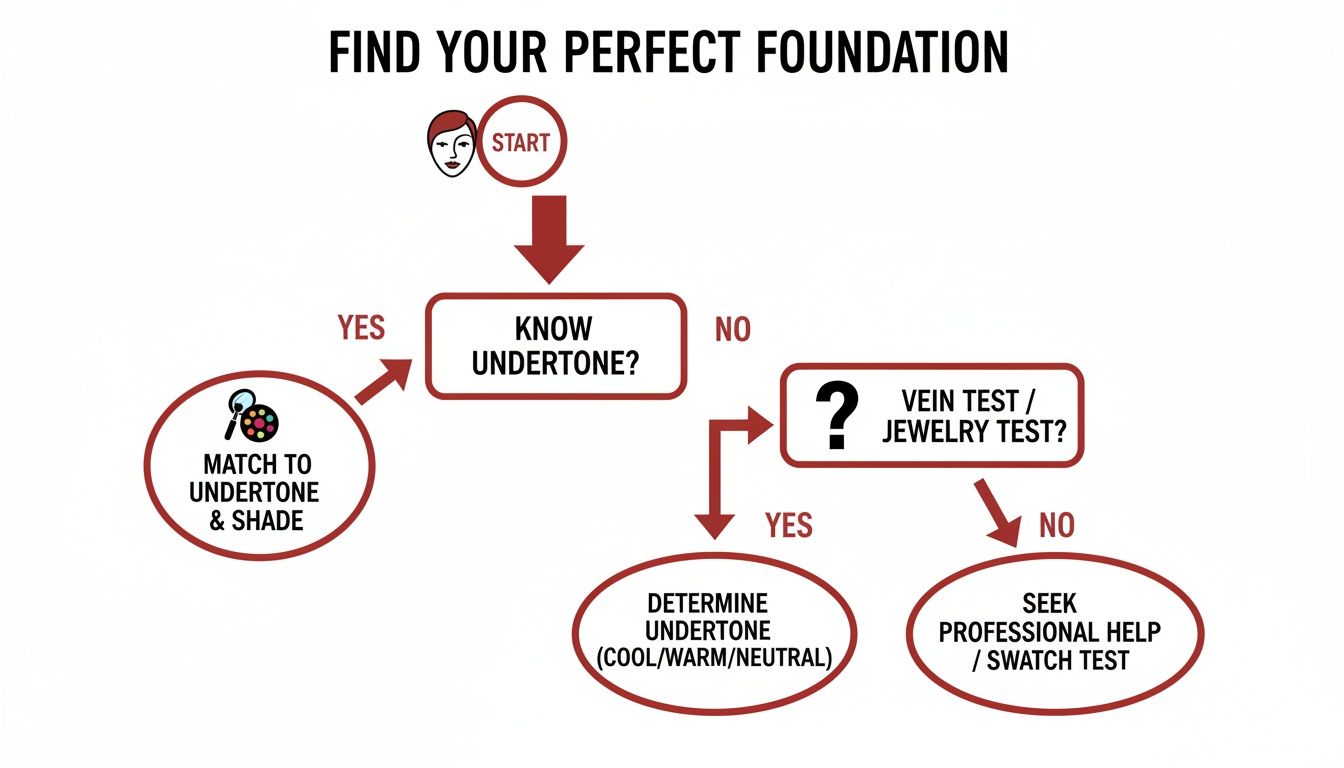
As you can see, figuring out your undertone is the first big fork in the road.
Simple Tests to Pinpoint Your Undertone
You don’t need any fancy gadgets for this. Just a little quiet observation and a couple of tried-and-true tricks can give you the answer in minutes.
The Vein Test
Take a peek at the veins on the inside of your wrist. Make sure you’re in good, natural daylight for this one. What color do you see?
- Blue or Purple Veins: You probably have cool undertones. This means your skin has subtle hints of pink, red, or blue.
- Green or Olive Veins: You’re most likely in the warm undertones camp, with hints of yellow, peach, or gold in your skin.
- Hard to Tell or Blue-Green Veins: If you're struggling to decide, chances are you have neutral undertones—a beautiful balance of both warm and cool.
The Jewelry Test
What kind of jewelry really makes your skin sing? Think about which metals give you that extra glow.
- Silver Shines: If silver, platinum, or even rose gold makes you look radiant, you likely lean cool.
- Gold Glows: If traditional yellow gold makes your skin pop, you’ve probably got warm undertones.
- Both Look Great: Can you pull off either without one looking obviously better? Hello, neutral undertones.
Pro Tip: Another quick check is to hold a crisp white T-shirt or piece of paper next to your bare face in natural light. If your skin looks rosy or pinkish in comparison, you're cool-toned. If it looks more yellow or golden, you're warm.
A Note on Olive Tones
Sometimes, undertones don't play by the cool-warm-neutral rules. Olive undertones are their own unique category, often a mix of neutral, warm, and a subtle green or ashen hue. It’s a common undertone that often gets misdiagnosed.
If you have olive skin, you’ve probably found that traditional warm foundations can look too orange and neutral ones can look too pink. If you’ve always felt like you’re somewhere in the "warm beige" family but nothing is quite right, you might be olive!
Recognizing this specific undertone is a game-changer for finding a truly perfect match. For a deeper dive, our guide on how to find your skin undertone can help you explore this even further.
The Best Way to Swatch Foundation In-Store
Alright, let's talk about finding your foundation shade in a real-life store. It can feel like a high-stakes mission, but with the right strategy, it's totally manageable.
The absolute biggest mistake I see people make? Swatching foundation on their hands or wrists. I get it, it’s easy. But the skin there is almost always a different color and texture than your face. This little shortcut is the number one reason people get home with a shade that’s completely wrong.
For a true match, you’ve got to test the foundation exactly where you’ll be wearing it. That means showing up to the store with a clean, makeup-free face if you can. It's the only way to match your actual skin, not the foundation you wore that morning.
The Jawline Swatch Method
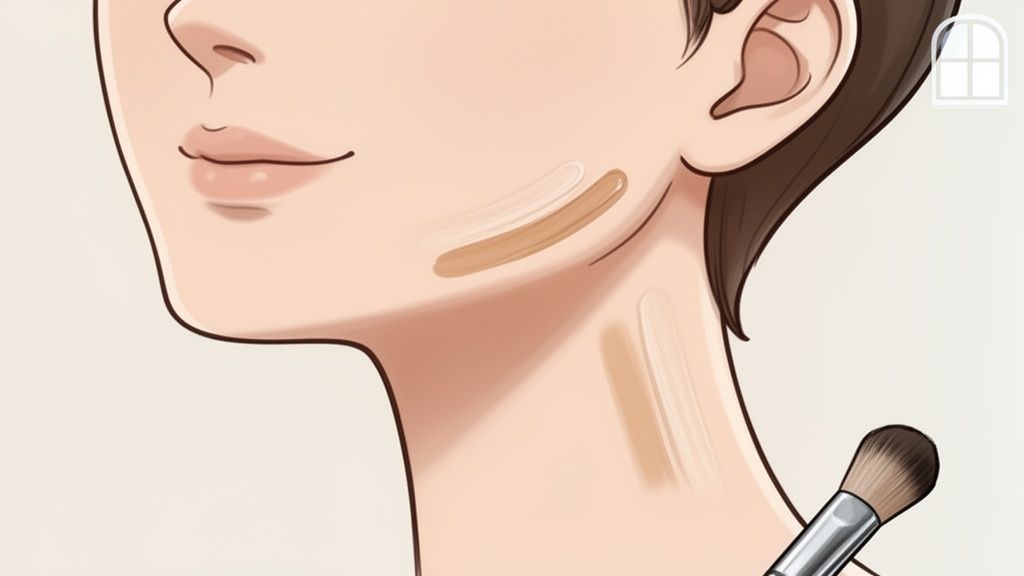
The sweet spot for testing is right along your jawline, bringing the color down onto your neck just a bit. This area is the perfect testing ground because it shows you how a shade bridges the gap between your face and neck, which is key for a seamless, "I'm not wearing makeup" look.
Here’s how the pros do it:
- Pick three contenders. Based on what you know about your undertone, choose three shades that look close. Grab your best guess, one that's a touch lighter, and one that's a touch darker.
- Apply small stripes. Dab a distinct stripe of each shade on your jawline. Don't blend them! You want to see them clearly, side-by-side.
- Wait. Seriously. This is the step everyone wants to skip, but it’s critical. Most foundations oxidize, which is just a fancy way of saying they get a little darker as they dry and mix with your skin's oils. Give it a solid 10-15 minutes to see the shade’s true color.
Once the swatches have dried down, the right shade should practically vanish into your skin. There shouldn't be an obvious line where the makeup stops and your skin begins. If a shade looks ashy, too pink, or weirdly orange, it’s an immediate no.
The winning shade is the one you can barely see. If you have to squint and ask yourself, "Is there anything even there?"—you've probably found your match.
Let's Talk Lighting and Samples
Here's a hard truth: store lighting is a liar. Those fluorescent bulbs can throw off all sorts of weird yellow or cool casts, completely changing how foundation looks. Once you have your stripes on, walk over to a window or, better yet, step outside with a hand mirror. Natural daylight doesn't lie.
And finally, never, ever be shy about asking for a sample of your top pick. Think of it as the ultimate test drive. It lets you wear the foundation for a full day to see how it feels, how it wears, and how it looks in all the different places you go. Just explain that you want to be 100% sure before buying, and most makeup artists are happy to help. Trust me, this one step will save you from so much buyer's remorse.
How to Find a Foundation Shade Online
Shopping for foundation online opens up a whole new world of options, but let's be real—it can feel like a total gamble compared to buying in person. When you can't swatch, how are you supposed to find your perfect shade with any confidence?
Good news: technology and some smart shopping habits have made it way easier to get it right from your couch. It all comes down to a mix of digital tools and a little bit of real-world testing.
Try Digital Shade Matching Tools
Virtual try-on features are a great start, giving you a surprisingly good idea of how a shade will look on your skin. Many brands also have detailed quizzes that consider your undertone, skin concerns, and even your current foundation to recommend a match.
One of the most reliable tricks is to cross-reference a foundation you already own and love. Websites like Findation and Match My Makeup are game-changers here. You just plug in a product you know works for you, and they'll spit out equivalent shades from hundreds of other brands.
Of course, for these tools to work, the website has to work. For consumers seeking to find their perfect foundation shade online, the performance of an e-commerce platform is crucial. Discover how optimizing a luxury skincare brand's website for faster site performance can enhance the customer experience.
It turns out that a huge 65% of Strong Cosmetics' customers now lean on these cross-brand tools, which brought in new buyers who were nervous about shopping for makeup online before. With satisfaction rates often over 90%, these tools are seriously boosting shopper confidence.
The Power of Ordering Samples
While digital tools point you in the right direction, nothing—and I mean nothing—beats trying the actual product on your own skin, in your own home. This is where samples become your absolute best friend.
Ordering a few promising shades is a low-cost, low-waste way to test-drive your options before committing to a full-size bottle.
Ordering samples empowers you to see how a foundation wears throughout the day, how it looks in different lighting conditions (your office, your car, outside), and how it feels on your skin. It completely removes the guesswork.
Brands like us here at Axiology are big fans of this approach, offering sample programs that also align with our sustainable values. It's not just practical; it's an eco-conscious choice that keeps mismatched products out of the landfill. It’s the final, crucial step to make sure your online pick is a winner.
Scrutinize Photos and Reviews
Don't just rely on the polished, professional photos on a brand’s website. You have to dive into the customer reviews and hunt for photos from real people who have a similar skin tone and undertone to you. This is where you'll find the truth about how a shade really looks.
When you're scrolling, pay attention to these details:
- Does the reviewer mention their undertone? This context is gold.
- How do they describe the shade? Look for keywords like "a true neutral," "slightly golden," or "has a peachy tint."
- What lighting are their photos in? A photo in natural light is always the most trustworthy.
Combining these digital tricks with the real-life proof of samples is the surest way to find your perfect foundation shade online. For more help, you might want to check out our dedicated foundation match finder guide to narrow down your options even more.
Finding Your Match with Axiology Fungdation
Okay, so you’ve got your undertone figured out. Now comes the fun part: finding your perfect foundation match.
Here at Axiology, this isn’t just about slapping some color on your face. It's about finding a formula that actually does your skin some good. That’s why we created Fungdation, our skin-renewing serum foundation that’s packed with powerhouse ingredients like reishi and snow mushrooms.
It’s incredibly lightweight and breathable, so you get a natural finish that never feels cakey or heavy. And you're in total control of the coverage—build it up from a sheer wash of color to solid medium coverage, whatever your skin needs that day.
How to Navigate the Fungdation Shades
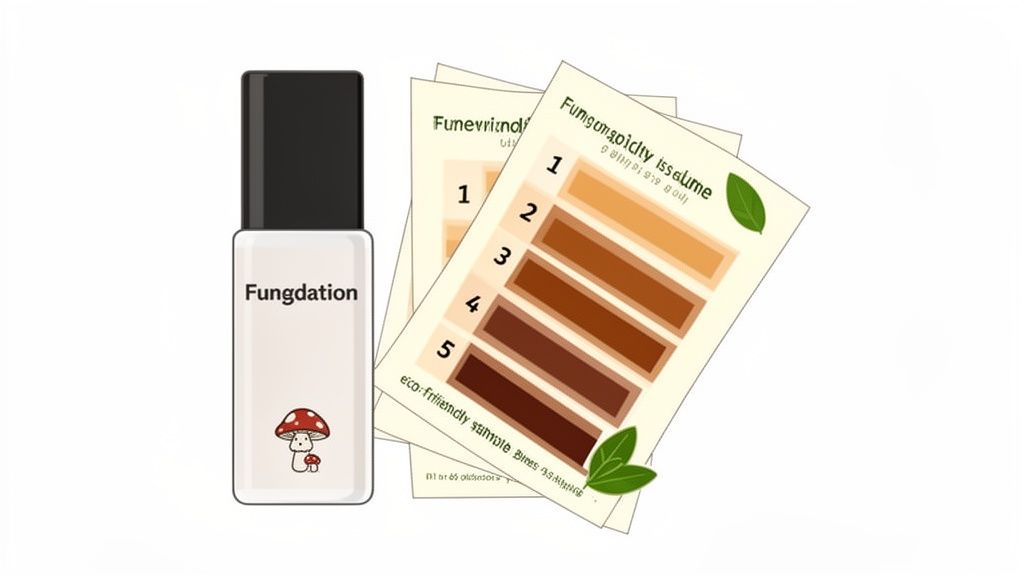
We've kept our shade system super simple. Each shade gets a number for the depth (from light to deep) and a letter that matches your undertone. Easy.
- C is for Cool undertones (think pink, red, or blueish hints).
- W is for Warm undertones (those yellow, peachy, or golden hues).
- N is for Neutral undertones (a nice balance of both).
This little system cuts out all the guesswork, letting you zero in on the shades that will actually look like your skin, but better.
It’s wild to think that many huge brands still only offer 30-50 shades, when skin-tone analysis shows there are more like 100-200 distinct tones out there. This gap is a huge reason the shade matcher market is expected to blow up to USD 1,757.4 million by 2035. People are tired of almost-right matches.
Trying before you buy is the most sustainable way to shop for makeup. It ensures you find a product you’ll love and use to the last drop, preventing waste.
The Axiology Approach to Sampling
We're big believers that the only way to really know if a foundation is for you is to test it in your own world, on your own time. That’s why we’re all about our sample program. You can try shades at home without having to commit to a full-size bottle.
Our samples come in sustainable packaging, so you can play around with different options without adding to the planet’s plastic problem. It's the ultimate test drive—you can see how Fungdation looks in office lighting, in sunlight, and how it holds up through your afternoon meetings.
Need a little help narrowing it down? Our Fungdation Shade Quiz can give you a personalized recommendation in a couple of clicks.
Plus, Fungdation's creamy, serum-y texture makes it a fantastic multi-tasker. Just tap a little extra onto any areas that need more love—like under the eyes or on a blemish—and it doubles as a lightweight concealer. It's a true hero product for anyone who loves minimalist, eco-conscious beauty.
Common Foundation Matching Questions
Even when you feel like you have a solid game plan, foundation matching can still throw you a curveball. It's totally normal. You might run into a few tricky situations that leave you second-guessing your choice.
Let's tackle some of the most common dilemmas head-on. Think of this as your troubleshooting guide for getting that perfect match.
What if My Shade Looks Different in Different Lighting?
This is probably the biggest frustration out there. You find a shade that looks absolutely perfect under the bright, fluorescent lights of a store, only to step outside and realize it’s completely off. What gives?
The culprit is almost always artificial lighting. It can cast weird yellow or blue hues that totally warp how a foundation's true color looks on your skin.
Natural daylight is your best friend here—it’s the ultimate truth-teller. Whenever you're swatching a new foundation, make it a non-negotiable rule to check it by a window. Better yet, step outside with a mirror. This simple move gives you the most accurate read on the color and can save you from a bad match.
Already brought a bottle home? Wear it for a full day and pay attention to how it looks in different spots—your car, your office, near a sunny window. You'll get a much better sense of its true character.
My Face and Neck Are Different Colors
Welcome to the club! Seriously, almost everyone deals with this. It’s super common for your face to be a slightly different shade than your neck and chest, usually because of sun exposure.
So, what’s the golden rule? Always match your foundation to your neck and chest.
The whole point is to create a seamless, unified look from your face all the way down. If you match the foundation to a tanner face, you risk the dreaded "floating head" effect where your face looks disconnected from your body. No thank you. Matching to your neck creates a cohesive canvas.
You can easily bring some warmth and dimension back to your face with a light dusting of bronzer on the high points—think forehead, cheekbones, and the bridge of your nose. This little trick ensures everything looks harmonious and completely natural.
How to Handle Seasonal Shade Changes
Our skin tone isn't static; it naturally shifts with the seasons. Most of us get a little deeper in the summer and lighter in the winter. But that doesn't mean you need a whole new foundation every few months. The most practical (and sustainable) approach is to have two key shades in your arsenal.
- Your Winter Shade: This is your lightest, truest color.
- Your Summer Shade: This is the shade that matches you at your deepest tan.
For those in-between months like spring and autumn, you can become your own custom-blend artist. Just mix a little of each shade together to create a bespoke color that perfectly matches your current skin tone. This method is way more cost-effective and cuts down on product waste.
A great tip is to use the back of your clean hand as a palette. Pump a little of each shade and mix with a brush or your finger until you get the perfect custom color for the day.
Can I Make a Wrong Shade Work?
Absolutely! A slightly-off foundation doesn't have to be a total loss. With a couple of clever tricks, you can easily adjust a shade and make it totally wearable.
If a foundation is a tad too light, blend a cream or powder bronzer around the perimeter of your face and across your cheekbones to add warmth. If it's a little too dark or orange, try mixing in a drop of a lighter concealer or even your daily moisturizer. This will sheer out the coverage and lighten the color at the same time.
For shades with the wrong undertone, a color-correcting primer can be a lifesaver. A green-tinted primer will help neutralize redness, while a lavender one can counteract sallowness, making a slightly-too-warm or too-cool foundation much more flattering.
Ready to put this knowledge to the test and find your perfect, skin-loving match? Explore Axiology's innovative, mushroom-infused Fungdation. Our sample program makes it easy and sustainable to discover your ideal shade from the comfort of your home. Find your flawless finish today.