When we talk about natural preservatives for cosmetics, we're talking about ingredients from plants or made through fermentation that stop nasty stuff from growing in your products. Think of them as tiny bodyguards for your favorite creams and serums, keeping them safe from bacteria, yeast, and mold.
It’s a simple concept, but it's completely shaking up the beauty industry and moving us away from the synthetic ingredients of the past.
Why Natural Preservatives Are a Game Changer for Clean Beauty

The whole conversation around beauty ingredients has gotten so much smarter. We've moved way beyond vague "chemical-free" labels. Shoppers today are savvy—they want to know exactly what’s in their products and they’re asking tough questions about the long-term effects of synthetics like parabens and formaldehyde-releasers. This curiosity is what's really fueling the demand for natural alternatives.
This isn’t just a trend; it's a movement led by you, the consumer, and it's pushing brands to get creative. The challenge now isn't just making a product that works, but making one with a clean, easy-to-understand ingredient list.
It's all about finding that perfect sweet spot: keeping a product totally safe from contamination while living up to the high standards of the clean beauty world. This has led many of the best clean beauty brands to totally rethink their formulas, pouring tons of resources into research and development.
The Market for Cleaner Formulas is Exploding
Let's be clear: the demand for safer ingredients is a huge market force. The global cosmetic preservatives market is currently valued at USD 372.71 million and is expected to jump to USD 617.07 million by 2033.
Guess what’s driving that growth? Natural preservatives. It’s all thanks to people wanting formulas that fit their health-conscious lifestyles and are gentler on sensitive skin. You can dig into the data on this market shift if you want the full scoop.
This shift represents a fundamental change in how we view product safety. It’s no longer about just preventing spoilage; it's about preserving both the product and the user's well-being with ingredients that are effective, gentle, and sustainably sourced.
This guide will be your tour through the world of natural preservatives for cosmetics. We’re going to break down the science of how they work, look at some common examples, and get real about the formulation challenges that brands like us here at Axiology tackle to bring you products that are safe, effective, and truly clean.
Get ready to understand the art and science of keeping your favorite products fresh, the natural way.
How Natural Preservatives Protect Your Products
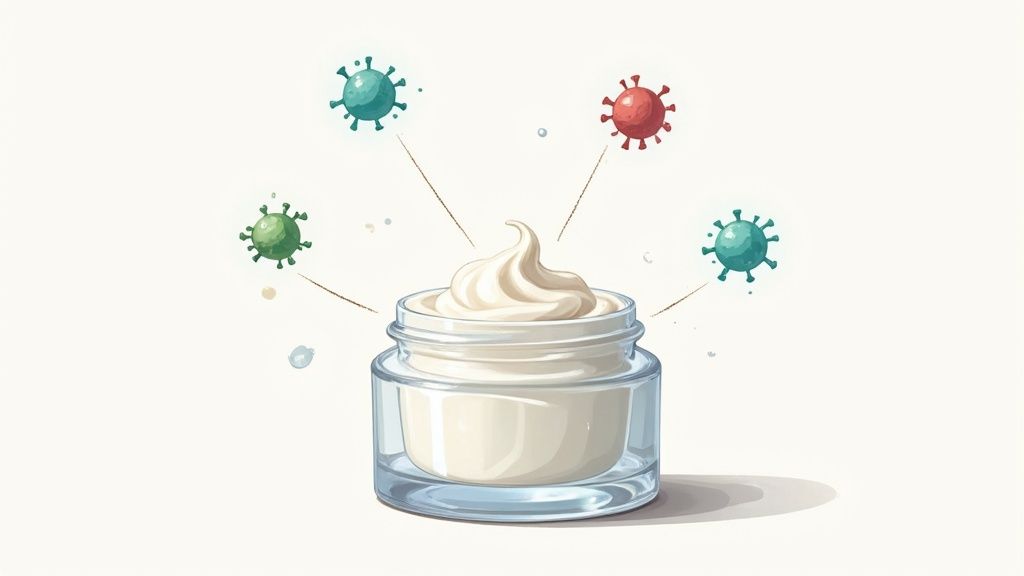
Let’s talk about how natural preservatives for cosmetics actually work. Think of your favorite face cream as a beautiful, nutrient-rich buffet. If you leave it sitting out, uninvited guests—like bacteria, yeast, and mold—are going to crash the party and spoil everything. Not a good look.
Natural preservatives are the security team for that buffet. They use some pretty clever tactics to keep the riff-raff out.
Some act like bouncers, changing the environment to make it totally unappealing for microbes. Others are more direct, getting right in there and messing with the microbes’ cell walls and metabolism, stopping them from functioning and multiplying. It’s this cellular-level disruption that keeps your products safe and pure.
Building an Unbeatable Defense System
Here’s the thing: one security guard can't protect the whole party, and the same goes for preservatives. Relying on a single natural preservative is a risky move because different microbes have different weaknesses. An ingredient that’s amazing at stopping bacteria might do absolutely nothing against a stubborn mold.
This is where broad-spectrum protection comes in. It’s a non-negotiable. The preservative system has to work against a whole range of potential contaminants, including:
- Gram-positive bacteria: The common type of bacteria living on our skin.
- Gram-negative bacteria: Tougher bacteria that love water-based formulas.
- Yeast: A fungus that can make products separate or get weirdly textured.
- Mold: Another fungus that shows up as fuzzy spots and can produce nasty toxins.
To get this kind of coverage, formulators create a "preservative cocktail," blending several natural ingredients. It’s a team effort that creates a defense system way stronger than any single ingredient could ever be.
Think of it like a superhero team. One hero has super strength (great against bacteria), another can go invisible (perfect for yeast), and a third can fly (stops mold in its tracks). Together, they offer total protection that no single hero could manage alone.
This smart, synergistic strategy is everything in modern natural cosmetic formulation.
Why Blends Are Better
Creating a blend of natural preservatives for cosmetics does more than just cover all the bases. It also means formulators can use smaller amounts of each ingredient. This is a huge win, because some natural preservatives, like certain essential oils, can be irritating if you use too much.
When you combine ingredients, their individual powers get amplified. One preservative might weaken a microbe’s defenses, making it way easier for another to swoop in and finish the job. The result? The formula is not only safer and more stable but also much gentler on your skin.
For example, certain plant extracts can give organic acids a major boost, allowing for a lower, milder concentration of both.
This intelligent blending is the real secret behind products that stay fresh and effective, from the very first pump to the last drop—all without ditching the clean, gentle philosophy we care so much about. It's a sophisticated science that keeps your products as pure as the day they were made.
A Practical Guide to Common Natural Preservatives
Dipping your toes into the world of natural preservatives for cosmetics can feel a little like learning a new language. With so many options out there, it really helps to break them down into families based on how they do their job.
Once you understand the basic groups, you'll start recognizing them on ingredient lists and appreciate what they bring to the table.
We can sort the most common natural preservative systems into three main buckets:
- Organic Acids and their Salts: These are the gentle but mighty workhorses, many of which are borrowed from the food industry.
- Essential Oils and Plant Extracts: Think of these as the multitaskers, offering both preservation and extra skin benefits.
- Bio-Ferments and Peptides: This is the newer, innovative crew that uses the magic of fermentation to create powerful antimicrobial goodies.
Let's unpack each category to see what makes them tick.
The Power of Organic Acids
Organic acids are true staples in natural cosmetic preservation. We're talking about ingredients like benzoic acid, sorbic acid, and salicylic acid. They work by making the product's environment just a little bit acidic—a place where most bacteria and fungi just can't thrive. It’s like creating a velvet rope that microbes can't get past.
The catch? Their effectiveness is super dependent on the product's pH level. They do their best work in formulas with a pH below 6.0, so you’ll often spot them in creams, lotions, and cleansers where the formulator can dial in the pH just right.
A perfect example of this is the duo of sodium benzoate and potassium sorbate. These are the salt forms of organic acids, which are generally more stable and easier for formulators to work with. They're incredibly common and have a long, trusted history of safe use in both food and beauty products.
Essential Oils and Plant Extracts
This is where preservation and skincare really start to overlap. Many botanicals—like tea tree oil, rosemary extract, and grapefruit seed extract—are packed with natural compounds that have serious antimicrobial muscle. They work by disrupting the cell membranes of microbes, stopping them right in their tracks.
But here’s the thing: using essential oils as the only preservative is a tough gig. To be truly effective, they often need to be used in high concentrations, which can risk skin irritation or give the product an overwhelming scent.
That's why they are almost always part of a bigger team, acting as a "booster" to beef up the overall preservative system. When you explore the world of natural makeup ingredients, you’ll see just how many plants pull this kind of double duty.
The use of plant-based antimicrobials is a modern application of ancient wisdom. Natural preservatives in cosmetics benefit from long-established methods adopted from the food industry, including the use of alcohol and salt. Today, the approach relies heavily on plant-based ingredients with proven antibacterial, antifungal, and antioxidant properties. You can explore further research on how these methods have been adapted for modern cosmetics.
Innovative Bio-Ferments and Peptides
Okay, welcome to the cool, cutting-edge side of natural preservation. Bio-ferments are made by fermenting beneficial microorganisms, like the same good bacteria used to make kimchi (Lactobacillus) or radishes (Leuconocstoc). This fermentation process creates incredibly powerful antimicrobial peptides.
These peptides work by poking tiny holes in the cell walls of harmful bacteria, causing them to fall apart. What’s so great about them is their precision—they go after the bad microbes while being gentle on your skin's natural, healthy microbiome.
You’ll see them on labels as Lactobacillus ferment and Leuconostoc/Radish Root Ferment Filtrate. They offer effective, broad-spectrum protection and often throw in some extra skin-soothing and moisturizing perks, making them a huge hit in modern clean beauty.
Comparing Popular Natural Cosmetic Preservatives
To help pull this all together, let’s put some of the most popular options side-by-side. Think of this table as a cheat sheet for understanding their strengths, challenges, and how they show up in your products.
| Preservative Name | Type | Pros | Cons / Challenges | Typical Use Level |
|---|---|---|---|---|
| Sodium Benzoate & Potassium Sorbate | Organic Acid Salts | Cost-effective, gentle, and widely available with a long history of safe use. | Highly pH-dependent; only effective in acidic formulas (typically pH < 6.0). | 0.1% - 0.8% |
| Benzyl Alcohol | Organic Alcohol | Provides broad-spectrum protection and is effective against bacteria and yeasts. | Can have a distinct almond-like scent and may be irritating to some individuals. | 0.5% - 2.0% |
| Rosemary Oleoresin Extract (ROE) | Plant Extract | Strong antioxidant properties that protect oils from going rancid; adds to the preservative system. | Not a standalone broad-spectrum preservative; must be combined with other antimicrobials. | 0.02% - 0.5% |
| Leuconostoc/Radish Root Ferment Filtrate | Bio-Ferment | Provides broad-spectrum antimicrobial protection and has moisturizing properties. | Can be more expensive and may require specific formulation conditions to remain stable. | 2.0% - 4.0% |
| Caprylyl Glycol & Ethylhexylglycerin | Glycols/Boosters | Act as "preservative boosters" that enhance the efficacy of other preservatives. | Rarely used alone; part of a larger system and can be synthetically derived. | 0.5% - 1.5% |
As you can see, there’s no single "best" natural preservative—it all comes down to the specific product, its pH, and the other ingredients in the mix. The real art is in blending these ingredients to create a system that’s both effective and gentle on the skin.
Overcoming Natural Formulation and Stability Hurdles
Making the switch from synthetic to natural preservatives isn't just a simple ingredient swap. It’s more like learning to cook with a whole new pantry of spices; each one has its own personality, its own strength, and its own rules. To create a product that’s both safe and stable, formulators have to navigate a few key challenges.
It all starts with understanding the unique world inside the cosmetic formula. Natural preservatives can be divas—they need the stage set just right to perform. Things like pH, solubility, and how they play with other ingredients aren't just minor details. They're critical factors that can make or break the entire product.
Navigating pH and Solubility
One of the biggest hurdles is pH sensitivity. A lot of popular natural preservatives, especially organic acids like sodium benzoate, only work their magic in an acidic environment, usually with a pH below 6.0. If the product's pH creeps up too high, the preservative basically clocks out, leaving your formula wide open to contamination. Formulators have to walk a tightrope, balancing the product's purpose with the preservative's very specific needs.
Solubility is another piece of the puzzle. Some of the most potent natural extracts and essential oils just don't like mixing with water. This can cause the preservative to clump up instead of spreading out evenly, creating little weak spots where microbes can start a party. To fix this, a formulator might need to bring in a solubilizer or tweak the recipe to make sure the preservative is fully integrated and active everywhere.
Getting these details right is what’s driving so much innovation in the beauty world. The market for natural skincare preservatives is expected to explode from USD 1,463.4 million to USD 4,921.3 million by 2035, and plant-based options are leading the charge. This growth isn't just a trend; it's a sign of a deep industry commitment to mastering these tricky formulations. You can discover more about these market trends here.
The Hurdle Technology Strategy
So, how do formulators build a strong defense with these sensitive ingredients? They use a brilliant strategy called hurdle technology. Instead of relying on one single, heavy-duty preservative, this approach sets up a series of smaller, gentler barriers that work as a team to stop microbial growth.
Think of it like a castle's defenses. You don't just have one big wall. You have a moat, a drawbridge, high ramparts, and archers. Any single hurdle might be easy to get past, but together, they make the castle almost impossible to breach.
In cosmetics, these hurdles could be things like:
- Adjusting the pH to a level where most microbes can't thrive.
- Controlling water activity by using ingredients like glycerin that "lock up" free water so microbes can't use it.
- Adding chelating agents, which grab onto the metal ions that microbes need to survive.
- Using airless packaging to keep contaminants from getting in.
This flowchart helps visualize the first few decisions a formulator makes when picking a preservative system based on what’s in the formula.
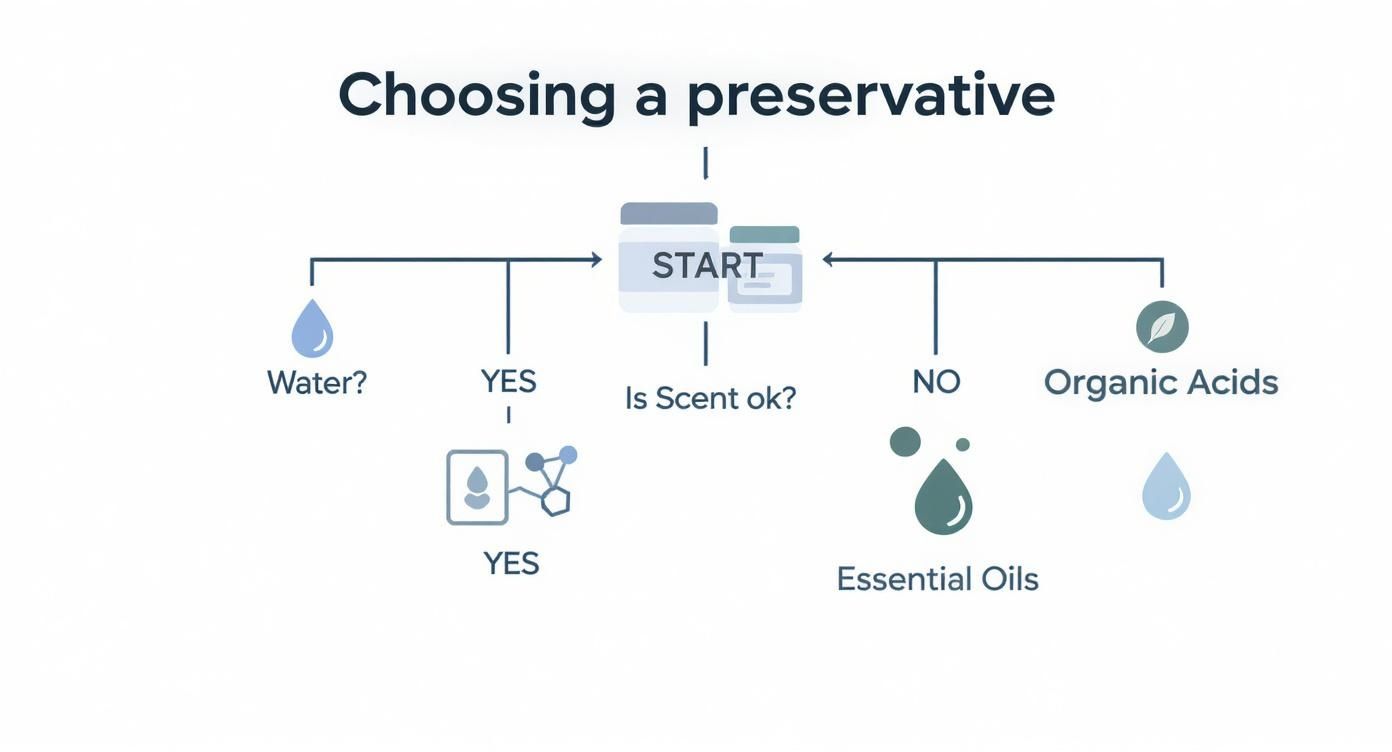
As you can see, the presence of water is the most critical first question, sending the formulator down different paths depending on other factors.
The Gold Standard of Safety: Challenge Testing
After all that careful formulating, how do we know for sure that a product is safe? That’s where preservative efficacy testing (PET), or "challenge testing," comes in. This is the non-negotiable, gold-standard gut-check for product safety.
In a challenge test, a lab deliberately contaminates a finished product with a nasty cocktail of bacteria, yeast, and mold. They then watch the product for 28 days to see if the preservative system can kill off the invaders and keep them from coming back.
Passing this intense test is the only way to prove a product can handle real-world conditions—from sitting in a steamy bathroom to being touched by fingers. For any brand that's serious about clean beauty, challenge testing isn't just another box to check. It's the ultimate promise of safety and quality to you.
Smart Alternatives and Self-Preserving Strategies
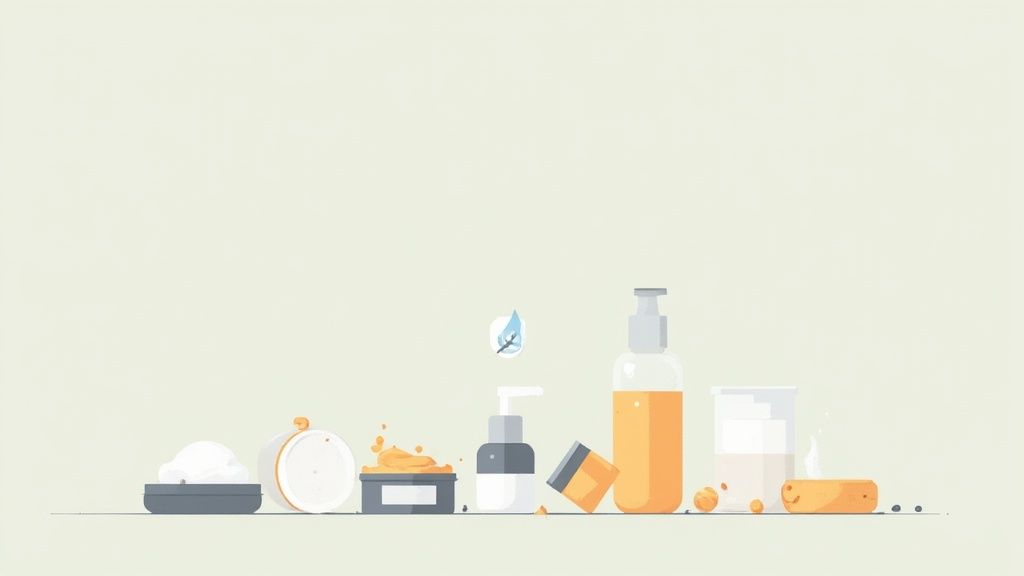
Sometimes the best way to keep a product fresh is to design it so cleverly it doesn't really need a traditional preservative in the first place. This is the whole idea behind self-preserving formulas, and it's a huge part of creating modern, sustainable beauty. It’s a shift in thinking—instead of just adding preservatives at the end, we create an environment where microbes just can't thrive.
The main principle is surprisingly simple: get rid of the water. Nasty stuff like bacteria and mold needs water to grow. Take away the water, and you stop the problem before it even begins. This is the secret to why many natural preservatives for cosmetics aren't even necessary for certain products.
Embracing Waterless Formulations
Anhydrous, or water-free, products are the rock stars of the self-preserving world. When you remove water, you create a naturally hostile place for germs, which means these formulas often only need an antioxidant to keep the oils from going bad, rather than a full-blown antimicrobial system. This doesn’t just make products safer; it also makes them more potent and concentrated.
You probably already use products like this. They’re often the most innovative and eco-friendly things in your bathroom cabinet.
Common examples of these self-preserving powerhouses include:
- Solid Bars: Think shampoo, conditioner, and cleanser bars that you lather up in the shower.
- Powdered Formulas: Dry masks and cleansers that stay totally inert until you decide to mix them with water.
- Oil-Based Serums: Those gorgeous face oils and serums made entirely from botanical oils and extracts.
- Rich Balms and Salves: Think lip balms and body butters with a thick, waxy texture that keeps everything out.
When you reach for these kinds of products, you’re choosing formulas that are stable by their very nature. It’s a more minimalist approach to beauty that cuts down on the need for a long list of preservatives.
A self-preserving strategy isn't about being "preservative-free" in a risky way. It's about intelligent product design where the formula itself—through low water content, specific pH levels, or high concentrations of ingredients like honey or salt—creates an environment that naturally resists contamination.
The Role of Intelligent Packaging
Beyond the formula, the package itself is your product's first line of defense. Contamination usually happens when we stick our fingers in a jar or leave a product open to the air. Smart packaging acts like a bodyguard, keeping the formula pure from the first pump to the last drop.
Brands that are serious about clean and sustainable beauty are leaning on packaging that actively protects what’s inside. This lets them use gentler preservative systems because the container is doing half the work.
Look for these types of protective packaging:
- Airless Pumps: These are brilliant. They use a vacuum to push the product out, meaning no air (and no contaminants) ever gets back inside.
- Opaque Bottles: Some ingredients are sensitive to light. Dark glass or opaque packaging acts like sunglasses for your serum, protecting it from breaking down and losing its power.
- Single-Use Pods: Perfect for potent treatments or masks, single-dose packs mean the product is perfectly fresh every single time, with zero chance of contamination.
It all goes to show that product safety is about the whole picture. By combining clever waterless formulas with protective, sustainable packaging, brands can create products that are safe, effective, and kinder to the planet.
Making Sense of Labels, Regulations, and Safety
Diving into the world of clean beauty can feel like you need a detective's license, especially when you're staring down an ingredient label. Let's bust one of the biggest myths right now: "natural" does not automatically mean "safer" or "allergy-free." While we love the power of botanicals, they are potent ingredients that deserve a healthy dose of respect.
Just because something is plant-derived doesn’t mean it can't cause a reaction. Essential oils are a perfect example—they're incredibly powerful extracts that can be irritating for some people. This is why patch testing any new product is always a good idea, particularly if your skin is on the sensitive side. It’s a super simple step that puts you in the driver's seat.
Here's the most important takeaway: Safety isn't a battle between natural and synthetic. It's about choosing well-formulated, properly tested products. A thoughtfully created formula with a proven preservative system is always the safest bet, no matter where its ingredients came from.
How to Read an Ingredient List
Becoming label-savvy is your ultimate superpower in the beauty aisle. The ingredient list, officially called the INCI (International Nomenclature of Cosmetic Ingredients), is your road map. Ingredients are always listed in descending order of how much is in the formula, so the first few items are doing most of the heavy lifting.
You’ll usually spot preservatives near the end of the list since they work their magic in tiny amounts, often less than 1%. Here’s what to look for when you're playing detective:
- Organic Acids & Their Friends: Keep an eye out for names like Sodium Benzoate, Potassium Sorbate, and Benzyl Alcohol.
- Powerful Plant Extracts: You might see things like Rosmarinus Officinalis (Rosemary) Leaf Extract or Melaleuca Alternifolia (Tea Tree) Leaf Oil.
- Cool Bio-Ferments: Look for ingredients such as Leuconoc/Radish Root Ferment Filtrate or Lactobacillus Ferment.
Recognizing these names helps you understand exactly how your products are staying fresh and safe. This kind of label literacy is a huge part of building a truly clean and non-toxic makeup routine you can feel good about.
What's the Deal with Certifications?
Ever see a logo like COSMOS or ECOCERT on a package and wonder what it really means? Think of them as third-party watchdogs that set super high standards for natural and organic cosmetics. They don't just glance at the final product; they inspect the entire supply chain from start to finish.
These certifications confirm that ingredients are sourced sustainably, processed in eco-friendly ways, and that the product hits specific targets for natural content. While they aren't a guarantee against a personal skin reaction, they give you an extra layer of confidence that a brand is serious about transparency and quality. They help you see past the marketing fluff to make truly informed choices.
Let's Talk Natural Preservatives
Dipping your toes into the world of natural beauty can bring up a few questions, especially when it comes to things like product safety and how long your favorite lipstick will last. Let's clear up some of the common head-scratchers about the natural preservatives for cosmetics that keep your products fresh and safe to use.
Are 'Preservative-Free' Cosmetics Actually Safe?
This is a fantastic question, and the answer isn't as simple as you'd think. A product that contains water and is truly "preservative-free" is basically an open invitation for bacteria and mold. Not good.
However, "preservative-free" often means the product uses clever formulation tricks to stay fresh instead of traditional preservative ingredients. Think of it as "self-preserving."
Here’s how formulators pull it off:
- Go Waterless: Products like oil serums and our solid Balmies naturally resist microbial growth because there's no water for germs to thrive in. Simple as that.
- Play with pH: Making a product very acidic or very alkaline creates an environment where microbes just can't survive.
- Use Smart Packaging: Airless pumps and single-use containers are designed to physically block contaminants from ever getting inside the product in the first place.
So, while the ingredient list might not call out a formal preservative, the product's entire design is what’s keeping it safe.
Can I Just Use Tea Tree Oil to Preserve My Homemade Skincare?
It’s a common thought, especially since essential oils like tea tree have well-known antimicrobial properties. But unfortunately, they just aren't strong enough to act as a standalone, broad-spectrum preservative in any product that contains water. They often can’t protect against certain types of mold or really tough bacteria.
To even have a chance, you'd need to use such a high concentration that it would almost certainly irritate your skin. For real safety, botanicals like tea tree oil should only be used as part of a complete, professionally formulated preservative system—one that’s been proven effective through rigorous challenge testing.
What’s the Shelf Life for Products with Natural Preservatives?
This one varies a lot. The shelf life for products using natural preservatives for cosmetics can be anywhere from 6 months to over 2 years. It all depends on the specific preservative blend, the type of formula it’s in, and the packaging.
A professionally made product will always give you a clear guideline. Look for the Period After Opening (PAO) symbol on the label—it looks like a tiny open jar with a number like "6M" or "12M" inside.
That number tells you exactly how many months the product is good for after you've opened it. Always stick to this guideline and store your products in a cool, dark place to keep them working their best.
At Axiology, we're committed to making makeup that’s not just beautiful, but also safe, vegan, and sustainable. Our formulas are designed with your skin and the planet in mind.
Explore our collection of innovative, plastic-free beauty products at Axiology.